Understanding why tires wear unevenly on the inside or outside is essential for every driver, especially since maintaining tire integrity means protecting the lives of passengers.
While rubber wear is a natural result of regular use, uneven or slanted tread wear is an immediate red flag indicating a mechanical or technical issue that requires attention.
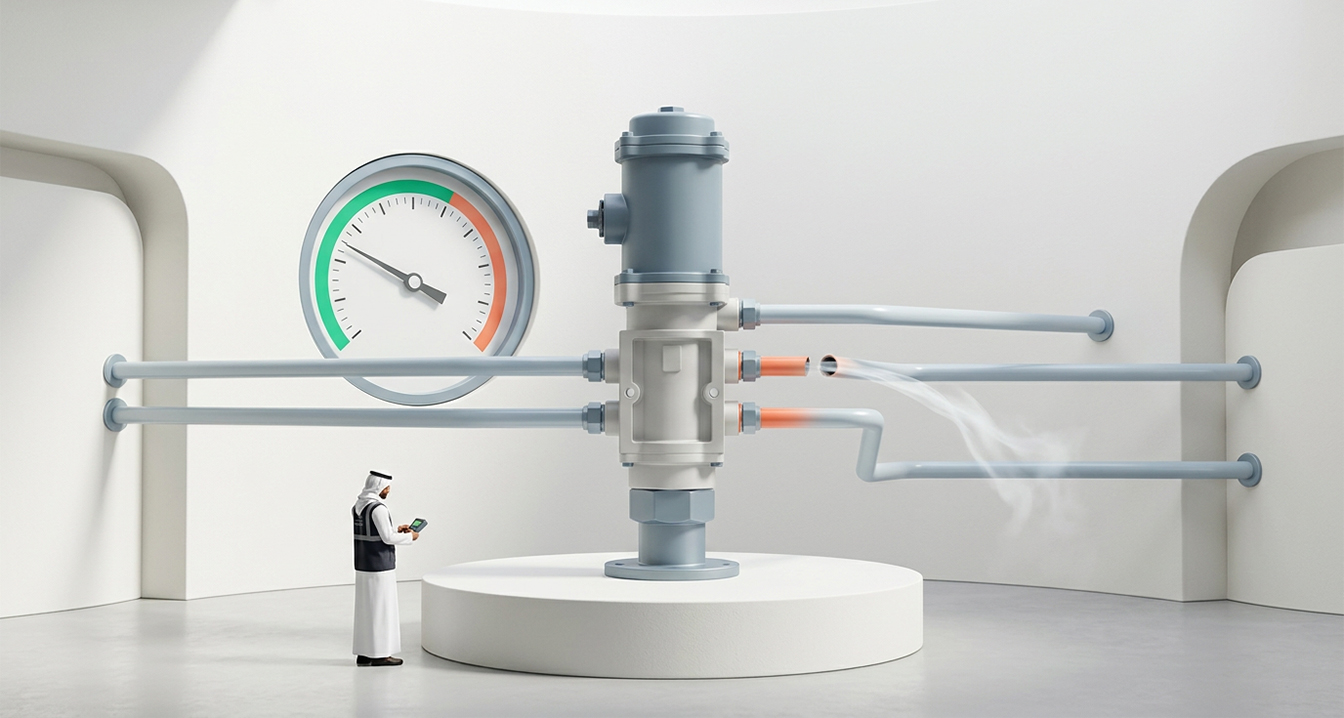
Simple issues, such as incorrect tire pressure, can be resolved quickly, though more complex problems may involve the suspension system or wheel misalignment.
In this article, we explore the primary causes of inner and outer tire wear, how to accurately diagnose each case, and the best practical solutions to ensure a safe drive and extend the lifespan of your tires.
"Uneven tire wear is a clear indicator of a mechanical or technical fault that requires urgent attention."
The Nature of Tire Wear
Before diving into the causes of inner and outer tire wear, it is important to understand that natural tire wear occurs evenly across the entire tread surface.
Uneven tire wear, however, points to an underlying issue that needs to be addressed. Ignoring it can lead to serious consequences, such as:
- Reduced road grip and stability.
- Increased risk of sudden tire blowouts.
- Higher fuel consumption.
- Costly repairs.
- Reduced tire lifespan.
Causes of Inner Tire Wear
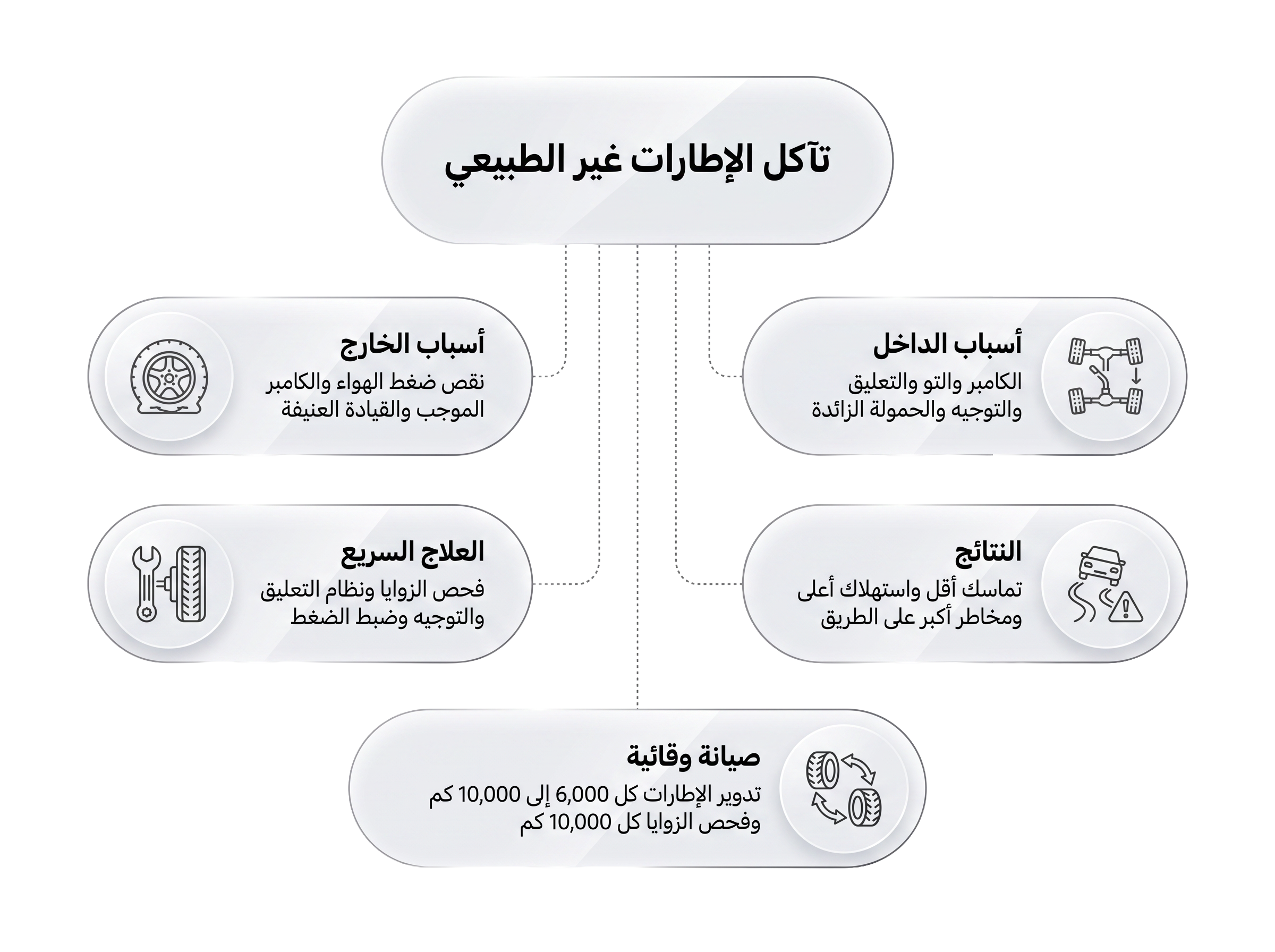
Inner tire wear is one of the most common patterns and is often linked to the following issues:
- Camber Angle Misalignment
The camber angle is a primary cause of inner tire wear, occurring when the wheels tilt inward or outward incorrectly.
When the camber angle is excessively negative—meaning the top of the wheel tilts inward—the vehicle's weight shifts to the inner edge of the tire, causing it to wear down faster.
"When the camber angle is excessively negative, the top of the wheel tilts inward, concentrating the vehicle's weight on the inner edge of the tire and causing it to wear out twice as fast as the rest of the tread."
- Toe alignment issues
The inner or outer edges of tires wear down when wheels are not properly aligned. Excessive "toe-out" causes the tires to pull outward while driving, creating extra friction on the inner edges.
- Suspension system problems
The suspension system is the most critical factor in balancing the load across the tires. If there is any defect, pressure is concentrated unevenly on the tire, leading to inner tire wear.
- Damaged tie rods
Worn tie rods also contribute to uneven inner tire wear. When steering components are faulty, the wheels lose their alignment, resulting in abnormal friction.
- Incorrect wheel alignment
Improper wheel alignment is a common cause of inner tire wear, as it prevents the wheels from sitting straight and causes uneven pressure distribution on the tire.
- Steering linkage issues
A defect in the steering linkage, often associated with steering pull, can cause the tires to wear on the inside.
- Overloading the vehicle
When a vehicle is loaded beyond its capacity, the axle bends downward, altering the suspension geometry and causing the inner edges of the tires to make more contact with the road.
Causes of outer tire wear
The most prominent causes of outer tire wear are as follows:
- Low tire pressure
This is the most common cause of outer tire wear. When a tire is under-inflated, its sidewalls flex more, causing the outer edges to bear most of the vehicle's weight, leading to rapid wear.
Additionally, an under-inflated tire tends to over-deflect and operate at higher-than-normal temperatures, which accelerates rubber wear and increases fuel consumption.
"An under-inflated tire does not support weight evenly; its sidewalls flex, placing the burden on the outer edges. As internal heat rises, rubber wear accelerates and fuel consumption increases."
- Excessive positive camber
When the camber angle is excessively positive—meaning the top of the wheel tilts outward—the vehicle's weight is concentrated on the outer edge of the tire, causing it to wear out faster.
- Overloading
Exceeding a vehicle's maximum load capacity increases pressure on the outer edges of the tires, particularly the rear ones.
- Aggressive Driving
Driving at high speeds over bumps and potholes, sudden braking, and sharp cornering all contribute to uneven tire wear and increased wear on the outer edges.
Other Wear Patterns
Beyond the two types of tire wear mentioned above, there are other patterns that can be identified and diagnosed as follows:
- Center Wear
This occurs when the center of the tire wears down faster than the sides. It usually indicates over-inflation, as an over-inflated tire causes the center of the tread to bear most of the load.
Wear on Both Edges (Inner and Outer)
If you notice wear on both the inner and outer edges, it usually indicates under-inflation. This is caused by insufficient tire pressure, which shifts the load to the outer edges on both sides.
- Feathering
This type of wear appears as a slanted or feathered pattern across the tread surface, and is usually caused by an incorrect toe alignment.
- Cupping or Scalloping Wear
This pattern appears as uneven spots or ripples around the circumference of the tire and is often caused by:
- Wheel imbalance.
- Damaged struts or shock absorbers.
- Worn wheel bearings or suspension joints.
The difference between front and rear tire wear based on the drivetrain system
Every vehicle has a different drivetrain that determines which tires work the hardest and, consequently, which will wear out faster. We’ve outlined this below to help you better care for your car's tires:
- Front-Wheel Drive (FWD) Vehicles
In this type, the engine and transmission are located at the front. The front wheels handle three main tasks simultaneously: transferring engine power to the road, steering the vehicle, and bearing the brunt of the braking force. The rear wheels have a limited role, simply following along.
In this case, front tires wear out up to twice as fast as rear tires. Studies indicate that front tires in FWD vehicles can account for 69% to 85% of total tire wear, wearing out 30% to 40% faster than rear tires under normal driving conditions.
"In front-wheel drive vehicles, the front wheels handle three heavy tasks at once: driving, steering, and braking. This causes them to wear out faster than the rear ones, which necessitates a different tire rotation pattern."
- Rear-Wheel Drive (RWD) Vehicles
Here, the situation is reversed; the rear wheels are responsible for driving the vehicle, while the front wheels handle only steering and braking. Consequently, the rear tires wear out faster in this type.
However, the difference in wear between the front and rear is less pronounced than in FWD vehicles, with front tires wearing 15-25% faster than the rear, rather than the 30-40% seen in FWD.
- Four-Wheel or All-Wheel Drive (4WD/AWD) Vehicles
In this type, engine power is distributed to all four wheels. While this helps achieve a more balanced wear pattern, the front tires still wear slightly faster due to the additional demands of steering and braking. The wear difference here is less severe, with front tires wearing 10-20% faster than the rear.
Why does the rotation pattern vary by drivetrain?
Since each drivetrain causes different wear patterns, the method for rotating tires also differs:
- Front-Wheel Drive
Move the rear tires to the front while switching sides ("forward cross").
- Rear-Wheel Drive and All-Wheel Drive
Move the rear tires to the front on the same side, while moving the front tires to the rear while switching sides.
Solving Tire Wear Issues
Addressing tire wear requires an accurate diagnosis of the mechanical and technical causes before taking any corrective action.
Below are the most effective solutions and practical steps to restore tire balance and protect them from premature damage:
- Adjusting Tire Pressure
The first and simplest step in addressing tire wear is ensuring proper tire pressure. You should check the pressure regularly—at least once a month—when the tires are at room temperature. Use a reliable pressure gauge and adjust the pressure according to the manufacturer's recommendations found in your owner's manual or on the driver's side door sticker.
- Wheel Alignment
If the wear is caused by improper wheel alignment, the solution is to have a professional perform an alignment. It is also recommended to check your wheel alignment every 10,000 km or whenever you notice the vehicle pulling to one side.
- Suspension System Inspection
All suspension system components must be inspected periodically, including shock absorbers, control arms, bushings, and springs. Any damaged part should be replaced immediately.
- Tire Rotation
Rotating your tires—changing their positions on the vehicle—helps distribute wear evenly and extends their lifespan. We recommend checking your owner's manual for the rotation pattern suitable for your vehicle.
- Wheel Balancing
If you notice "cupping" wear, it may be caused by wheel imbalance. In this case, you should have a dynamic wheel balance performed at a specialized service center.
- Improve Your Driving Habits
Avoid aggressive driving, sudden braking, and driving at high speeds over bumps and potholes. Remember that smooth, balanced driving significantly helps extend the life of your tires.
Expert Tips for Extending Tire Life
The experts at "Darbak" offer a set of important tips to help you avoid the causes of inner and outer tire wear:
- Regularly measure your tire tread depth using a dedicated gauge or the coin test. If the depth is 3 mm or less, it means the tires have lost their grip and must be replaced immediately.
- Choose high-quality tires from reputable companies like Darbak Company, as they are equipped with advanced technologies suitable for wet and dry roads as well as desert environments, which extends their lifespan and improves safety.
- Be sure to have your wheel alignment checked periodically; this prevents uneven tire wear and improves steering control.
- Rotate your tires every 6,000 to 10,000 kilometers, or as recommended by the manufacturer, to ensure even tread wear across all tires.
- Check tire pressure at least once a month and before long trips. Remember that proper inflation prevents sudden blowouts and improves fuel efficiency.
In any case, regular tire maintenance—including inspection, adjustment, and rotation—is essential. This reduces long-term costsand enhances both safety and driving comfort, especially given road conditions in the Kingdom.