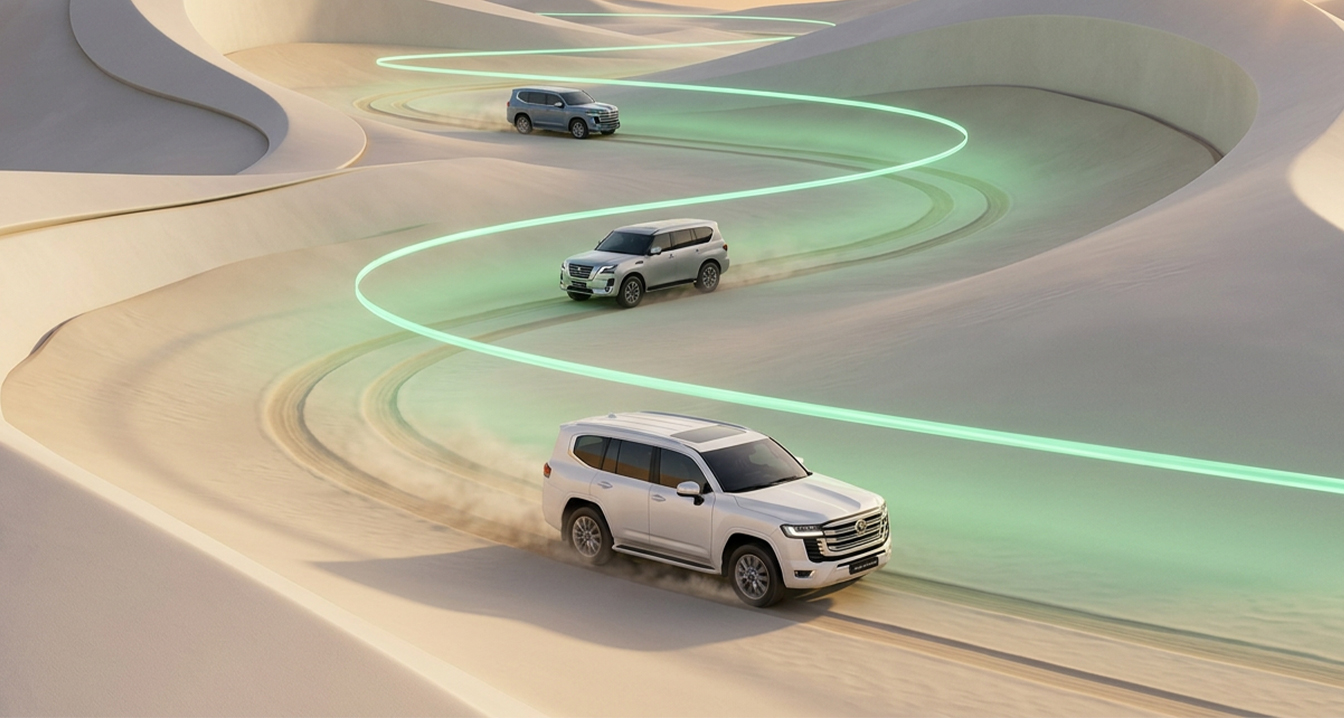
You may love desert driving and enjoying the stunning natural scenery, but you cannot guarantee a safe and smooth trip unless you follow a set of tips before and during your time on the sand.
How about we take you on a quick tour where we share the best practices from experienced drivers and experts to ensure your safety and the safety of those around you while driving in the desert?
Why do some people prefer desert driving?
Beyond being a means of transportation, some consider desert driving a source of enjoyment, challenge, and tranquility. It also:
1. Provides a sense of freedom and adventure.
2. Attracts those who love a challenge and want to showcase their vehicle handling skills.
3. Offers a sense of excitement and calculated risk.
4. Serves as a sanctuary for those looking to relax and escape the noise.
5. Features breathtaking natural views, including sunrises, sunsets, clear skies, and stars.
6. Is perfect for group trips, camping, and strengthening social bonds.
7. Is an ideal destination for explorers and photographers.
8. Is suitable for those who enjoy off-roading, rallying, and endurance racing.
However, desert driving—especially over long distances—requires thorough preparation, including sufficient fuel, water, food, and communication tools, in addition to the helpful tips we will provide to ensure a safe and smooth drive.
Preparing for a Desert Driving Trip
We all know the desert environment is harsh, so you must always be prepared for the unexpected. Before you start your journey, commit to these 7 tips that will surely help you ensure a safe and smooth drive in this environment:
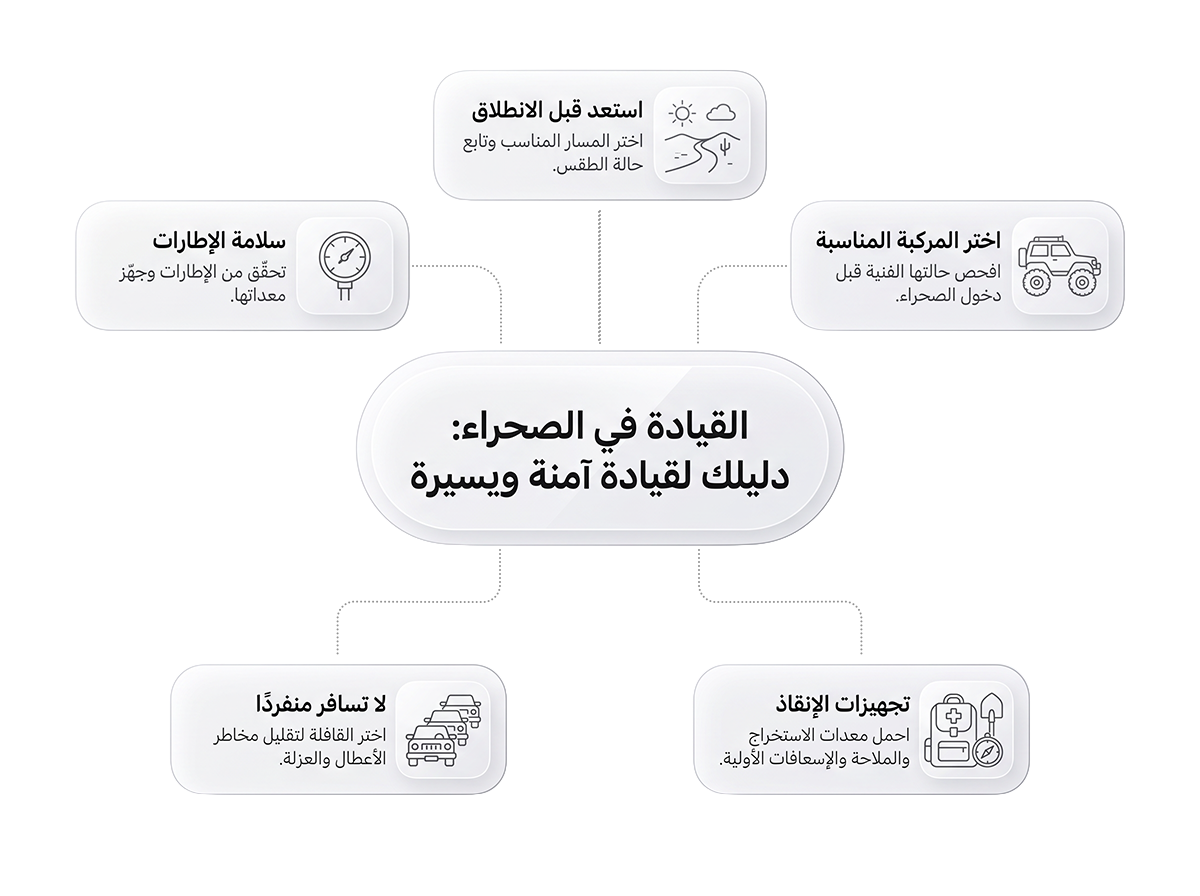
1. Choose the right vehicle for sandy terrain. Many prefer 4x4 vehicles because they are capable of handling rugged terrain. In any case, you should be confident in your vehicle's capabilities before heading out.
2. Make sure to check your vehicle's tires and thattire pressure the pressure is appropriate, while also inspecting the engine, brakes, and battery. Don't forget to check the spare tire and the repair toolkit.
3. Ensure you have tools for emergencies, including traction boards, a shovel, navigation tools, a paper map, an air compressor, etc.
4. Make sure to pack plenty of drinking water, non-perishable snacks, a first-aid kit, and a flashlight.
5. Check the weather forecast for the period you will be driving in the desert and take necessary precautions.
6. Plan your route carefully by studying maps, identifying start and end points, understanding the terrain, and noting hazardous areas. Always inform someone close to you of your route and expected return time.
7. Traveling in a convoy ensures immediate support to call for help and efficiently handle any breakdowns or getting stuck in the sand.
"The desert environment is harsh, so you must always be prepared for the unexpected and follow expert advice for a safe and smooth journey before you head out."
Essential equipment for desert driving
In this section, we have compiled all the tools you might need while driving in the desert:
1. Tow rope or winch.
2. Traction boards.
3. A shovel to clear sand from around the tires.
4. Offline navigation apps.
5. GPS device or compass.
6. A paper map to use if electronic devices fail.
7. Two-way radios.
8. A satellite phone, which is useful for long trips or very remote areas.
9. At least 3 liters of water per person per day.
10. Non-perishable foods such as nuts and dried fruits.
11. First-aid kit.
12. Flashlight and spare batteries.
13. Sunscreen and sunglasses.
14. Clothing suitable for changing weather conditions.
15. Tire pressure adjustment equipment.
16. Tire pressure gauge.
Other rules for ensuring safe desert driving
1. Start by driving on open, easy sandy paths to gain experience before moving on to rugged terrain and dunes.
2. Use 4-Low (4L) and a low gear (first or second), disable ABS if possible, and let the engine brake the speed while applying very light pressure to the brakes when necessary.
3. Do not attempt to turn left or right if the vehicle loses speed while climbing a slope; instead, reverse in a straight, safe path to try again.
4. Avoid driving fast on sharp sand ridges to prevent the sand from collapsing or the vehicle from rolling over.
What to do if a problem occurs while driving in the desert?
Below are some tips on how to handle common problems that may occur while driving in the desert:
- Vehicle stuck in the sand
If your vehicle gets stuck in the sand, stop immediately and turn off the engine so the vehicle does not sink further from continued acceleration.
Get out of the vehicle, check the depth of the sand, and clear the sand from in front of and behind the tires using a shovel. If the vehicle is only slightly stuck, try the rocking technique in 4L mode, using first gear and reverse gently to move the vehicle back and forth to level the path and build momentum. You can also place traction boards or any material that provides grip under the tires.
If you are completely stuck, stay with your vehicle and wait for help; it is much easier to find a car than a person on their own.
"If your vehicle gets stuck in the sand, stop immediately and turn off the engine so the vehicle does not sink further from continued acceleration."
- Mechanical breakdowns
If your vehicle breaks down in the desert, you should stay near it and use warning triangles or lights to signal for help. If you are in a convoy, you can notify others using available communication devices.
- Sandstorms
If you encounter a sandstorm while driving, you must stop immediately and pull off the road, turn on your hazard lights, and try to position the rear of the vehicle against the wind to minimize windshield damage from sand particles. Experts warn against attempting to continue driving in zero-visibility conditions, as this poses a significant danger.
- Heatstroke or heat exhaustion
These are both serious conditions. Heatstroke involves a high body temperature, dry skin, and loss of consciousness. Symptoms of heat exhaustion include heavy sweating, dizziness, weakness, nausea, and muscle cramps. If you experience any of these symptoms, stop driving immediately, move to a cool, shaded area, lie down with your feet slightly elevated, use cool water to lower your body temperature, and seek medical assistance.
What are the risks of driving alone in the desert?
It is common knowledge that any problem in the desert can quickly escalate into a major crisis, especially when there is no one to help you. Here are the most significant risks:
Getting stuck in the sand is the most common challenge for desert drivers, even experienced ones. If you are alone, you may have to dig for hours under the sun. Incorrect attempts to free the vehicle can cause it to sink deeper, and you may run out of energy and water before succeeding due to the physical strain and heat.
Mechanical breakdowns: Any minor issue becomes a disaster in the desert when you are alone. There is no one to help with repairs or towing, you may lack the necessary spare parts or tools, and you might be forced to walk in search of help, which is extremely dangerous.
Most desert areas lack cellular coverage. Without a satellite phone or a powerful two-way radio, you will be unable to call for help, and no one will know your exact location. Your phone battery may die before you get a signal, and the lack of landmarks makes it difficult to find your way back, especially after wind shifts or nightfall.
Driving on sand consumes significantly more fuel than driving on paved roads due to sand resistance and the use of four-wheel drive. If you are alone, you risk running out of fuel with no nearby gas stations. Running out of fuel means a complete stop, which may force you to abandon your vehicle and walk.
Health risks, most notably heat, dehydration, and exhaustion, are among the most dangerous threats in the desert and can be fatal if not treated quickly. This is in addition to injuries from falls, scorpion or snake bites, or accidents while digging or jacking up the vehicle.
Sandstorms can completely obscure visibility in seconds. You may lose your direction, go off-course, or collide with an unseen obstacle. The vehicle could be damaged or stop working due to sand, and there is no one to guide you or help you reach a safe location.
Dry wadis can turn into flash floods after heavy rain. You could get stuck in a flood path without warning, or the water could sweep away or submerge your vehicle. Furthermore, mud and wet sand after a flood make driving much more hazardous.
Accidents and rollovers: Driving on sand dunes requires high skill. You could roll the vehicle on a ridge, lose control while descending a dune, or hit an unseen hole or rock.
Security risks in some remote areas, such as encountering illegal activities, theft, assault, suspicious individuals, or unintentionally entering restricted or military zones.
Loneliness in the desert can cause anxiety, panic, poor decision-making, mental fatigue, or a sense of isolation and hopelessness when help is delayed. This may lead to rushing while driving or walking, which further increases the danger.
If you must drive in the desert alone, we recommend the following:
- Do not go out alone unless absolutely necessary; it is always better to have a second vehicle.
- Inform a trusted person of your route and expected return time.
- Carry a satellite communication device, not just a regular mobile phone.
- Bring enough water—3 to 5 liters per person per day—plus an extra reserve.
- Carry spare fuel, food, a first-aid kit, traction boards, an air compressor, and a spare tire.
- If your vehicle breaks down, stay with it; it is your best shelter and the easiest place for rescuers to find you.
- Avoid driving at night in unfamiliar areas.
- Learn sand driving techniques before heading out on an adventure.
- Monitor the weather and avoid valleys during rainy conditions.
- Stick to established trails and do not wander off-course.
"If your vehicle breaks down, stay with it; it is your best shelter and the easiest place for rescuers to find you."
Common mistakes when driving in the desert
1. Attempting to force the vehicle out, repeatedly rocking it, or shifting gears erratically while moving, which can cause the engine to overheat and damage the drivetrain and transmission.
2. Driving for long periods in a very low gear, which keeps engine RPMs excessively high while reducing airflow through the cooling system, ultimately leading to engine overheating and damage.
3. Driving too slowly on soft sand, which causes the tires to sink and the vehicle to get stuck.
4. Driving straight over obstacles is a mistake that can damage the undercarriage. The correct approach is to angle the vehicle so that one wheel handles the obstacle at a time, ensuring the other wheels maintain traction on solid ground.
5. Driving at high speeds over rough terrain increases the risk of the vehicle's underbelly striking rocks, which can puncture the oil pan, tear exhaust systems, and damage suspension components.
6. Failing to park with the rear of the vehicle facing the wind, leaving the engine running during storms, parking on downward slopes, or over-relying on brakes in sand or mud, which can cause the vehicle to get stuck.
"The difference between a safe trip and an adventure that ends in getting stuck or a blowout often starts with your tires, so take a few minutes to inspect them before you start the engine and head for the dunes."
In conclusion, desert driving requires special skills. The difference between a safe trip and an adventure that ends in getting stuck or a blowout often starts with your tires, so you should give them a few minutes of inspection before you start the engine and head for the dunes.
Browse our collection of Darbak tires, or contact our team to choose the most suitable size and pressure for your vehicle and the type of trips you take.