When is your braking distance longer? Imagine you are driving on King Fahd Road in Riyadh at 120 km/h, and suddenly a truck stops in front of you without warning. Do you know exactly how many meters your car needs to come to a complete stop?
The number might shock you! Under ideal conditions, you need more than 100 meters. However, if the road is wet or your tires are worn, this figure can double to over 200 meters.
In this comprehensive guide, you will discover when braking distance is longer, the hidden factors that increase it without you realizing, and how to protect yourself and your family on the roads of Saudi Arabia.
"Do you know how many meters your car needs to stop? Under ideal conditions, it's over 100 meters, and with worn tires or a wet road, that number can double to 200 meters."
Braking distance, reaction distance, and stopping distance: What is the difference?
These three terms are often confused by drivers, even though the difference between them represents the critical meters needed to avoid an accident. Here is an explanation of each:
- Reaction distance
This is the distance your car travels from the moment you see a hazard until you move your foot and actually press the brake pedal. It depends entirely on your speed and your human reaction time, which usually takes about one second.
- Braking distance
This is the distance the car travels after you press the brakes until it comes to a complete stop.
Total stopping distance
This is the total sum of both stages; the entire distance from the moment a hazard appears before your eyes until the car comes to a complete standstill.
We can summarize these three definitions with the following equation: Total stopping distance = reaction distance + braking distance.
Remember that human reaction time is about one second on average, and it can increase to 1.5 seconds or more when you are tired or distracted by your phone. During that single second alone, a car traveling at 100 km/h covers nearly 28 meters before braking even begins.
Therefore, when we ask: "When is braking distance longer?" we are talking about the actual distance after braking begins, but we must never overlook the reaction distance that precedes it.
How can you calculate braking distance yourself?
Did you know that you can estimate your car's braking distance with a simple calculation? Here is how:
Use this equation for ideal conditions (dry road, tires in good condition, and functional brakes):
Braking distance = (Speed ÷ 10)² × 0.4, provided the speed is in km/h.
Practical example: At a speed of 70 km/h, remove the zero from the speed to get 7, then multiply the number by itself: 7 × 7 = 49. Then, multiply the result by 0.4: 49 × 0.4 = 19.6 meters.
So, the braking distance at 70 km/h is approximately 20 meters.
"Under normal conditions, braking distance is calculated using the following formula: (Speed ÷ 10)² × 0.4"
When is the braking distance longer? Factors affecting braking distance
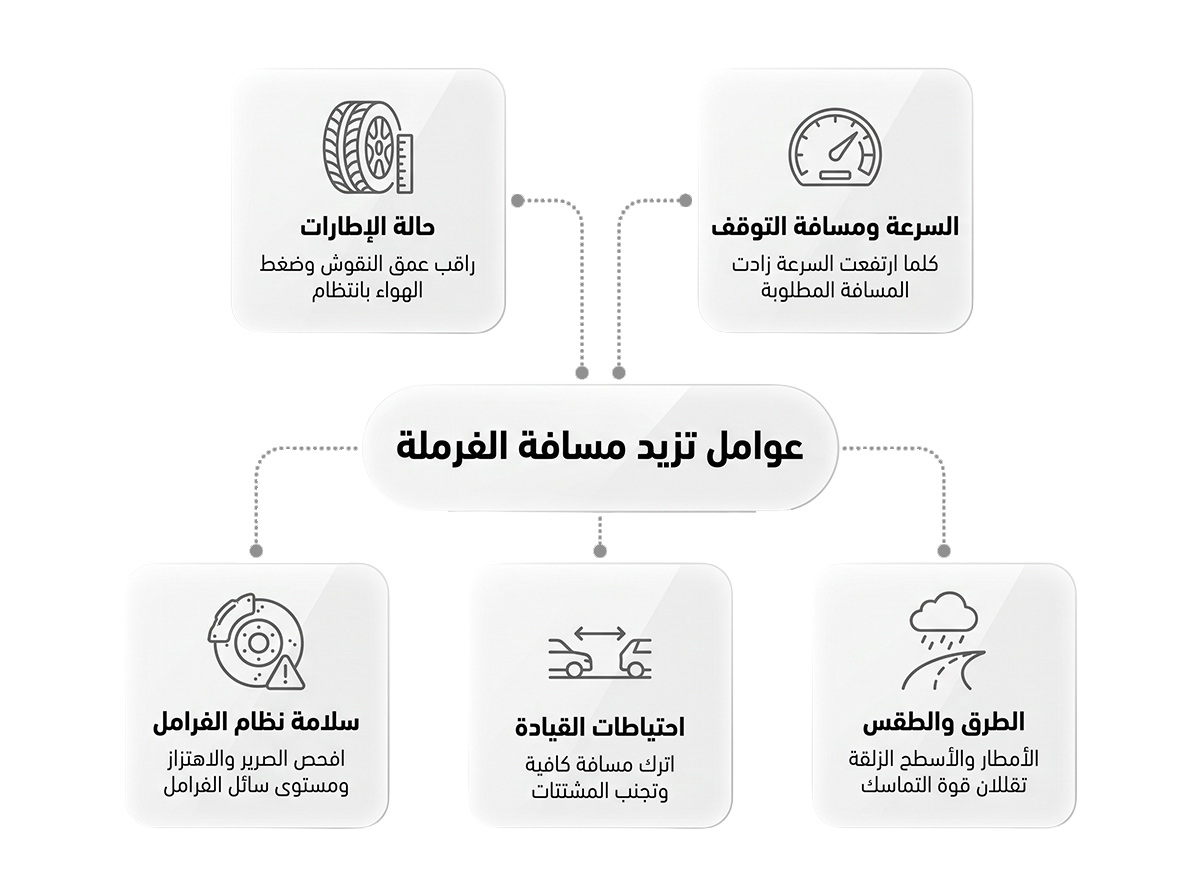
There are several factors that determine when the braking distance becomes longer. You can control some of them directly, while others are beyond your control. Here is a detailed breakdown of each factor:
- Speed
Did you know that doubling your speed doesn't just double your braking distance—it quadruples it? This is because a vehicle's kinetic energy increases with the square of the speed, not the speed itself.
For example, a car traveling at 50 km/h on a dry road needs about 12.5 meters to stop once the brakes are applied. However, that distance increases to 50 meters at 100 km/h. At 120 km/h—the maximum speed limit on highways in Saudi Arabia—a car requires more than 70 meters to come to a complete stop under optimal conditions.
From the above, we can conclude that the answer to the question "When is the braking distance longer?" is closely tied to the speed you choose, and that every additional 10 km/h increases the braking distance by more than 20%.
- Tire condition
Tires are responsible for transferring braking force to the asphalt. When tire treads wear down, their ability to channel water decreases, which sharply reduces friction.
A new tire with an 8 mm tread depth provides a braking distance of about 26 meters on a wet road at 80 km/h. When the depth drops to 3 mm, that distance increases to 32 meters, and it jumps to 43 meters at the legal minimum tread depth of 1.6 mm—a 65% increase compared to a new tire.
This risk is heightened in Saudi Arabia due to fine sand, which acts as an abrasive between brake pads and rotors, accelerating the wear of both. Furthermore, high temperatures exceeding 50°C in the summer dry out the tire rubber and cause cracking, even if the tread appears to be in good condition.
"A new 8 mm tire brakes on a wet road in 26 meters; at a 1.6 mm depth, the distance jumps to 43 meters, an increase of 65%."
- Road surface condition and weather
A wet road reduces the coefficient of friction by 40% to 50%, thereby doubling the braking distance. This increase can reach up to four times the distance during heavy rain or when driving through puddles.
However, the problem in Saudi Arabia is not limited to rain. Drivers also face dust and sand accumulated on highways, which creates a slippery, mud-like layer—especially during the first rainfall after a long dry spell. In these cases, the road becomes extremely slippery without the driver even realizing it.
Additionally, gravity increases braking distance on downhill slopes because it pushes the vehicle forward, while uphill slopes help reduce it. This is particularly important on mountain roads in regions like Abha and Al-Baha.
- Vehicle weight and load distribution
When a vehicle is loaded with luggage or passengers, its mass increases, which in turn increases the amount of kinetic energy that must be dissipated by the brakes.
Furthermore, uneven load distribution affects how braking force is distributed between the front and rear axles, leading to longer braking distances and a loss of stability. This means that your braking distance is directly related to the number of passengers and the amount of luggage your car is carrying.
- The braking system itself
The braking system directly affects the braking distance in the following ways:
1. The more efficient the system and the better the condition of its components, the shorter the distance required for the vehicle to come to a stop.
2. When brake pads or discs are worn, the friction force needed to slow the vehicle decreases, requiring more time and a longer distance to stop.
3. Frequent use of the brakes, especially when driving downhill, causes them to overheat. As the temperature rises, the coefficient of friction drops, which in turn increases the braking distance.
4. Low brake fluid levels or air bubbles in the lines weaken the transmission of hydraulic pressure, which increases the stopping distance.
5. The Anti-lock Braking System (ABS) helps reduce stopping distance when driving on slippery or difficult roads by preventing the wheels from locking up during braking, allowing the driver to maintain control of the vehicle.
How to avoid increased braking distance: Practical and effective strategies
Now that you know the answer to the question posed at the beginning of the article—when is the braking distance longer?—it is worth noting that a skilled driver masters defensive driving techniques and knows how to brake with maximum efficiency in emergencies.
Therefore, enrolling in advanced driving courses is a real investment that raises your traffic awareness and makes your response on the road faster and safer. Below are effective solutions to avoid increased braking distance:
- Maintain a safe following distance
One of the best practical ways to estimate the safe distance between you and the vehicle in front is to rely on time rather than measuring distance in meters. Experts recommend maintaining an appropriate time gap that allows you to react and stop safely, increasing this gap when driving in difficult conditions such as rain, fog, or dust, as visibility may decrease and the time required to stop increases.
The General Directorate of Traffic in Saudi Arabia has emphasized that failing to leave a safe distance between vehicles is a traffic violation with a fine ranging from 150 to 300 SAR, as it is one of the leading causes of traffic accidents.
- Check your tires regularly
Tires are subjected to double the stress in Saudi Arabia's hot climate, so you should: Check the tread depth monthly using a depth gauge, ensuring it is no less than 3 mm. You must also check tire pressure weekly, preferably early in the morning before the tires heat up.
Remember that a tire underinflated by 20% puts you at risk of a sudden blowout on hot roads, increases your braking distance, and reduces steering precision.
A tire underinflated by 20% puts you at risk of a sudden blowout on hot roads and increases your braking distance.
- Adjust your speed to road conditions.
Don't always drive at the speed limit, as it is intended for ideal conditions only. You should reduce your speed when it rains, in heavy dust, or when driving on unfamiliar roads. Remember that doubling your speed quadruples your braking distance.
- Use engine braking on downhill slopes.
When descending long hills, avoid riding the brakes, as this causes them to overheat and lose effectiveness. Instead, shift into a lower gear to engage engine braking, and use the brakes only lightly and intermittently when necessary.
- Avoid distractions
Driver alertness determines reaction distance. For example, using a phone while driving can double your reaction time, as you may be preoccupied with your device and not looking at the road for several full seconds. This means the car travels dozens of meters "blind," with no chance to brake.
- Know your vehicle's limits
Every vehicle has different braking characteristics. For instance, a small car with new tires behaves differently than a pickup truck loaded with furniture. Before a long trip, you should test your braking in a safe area to get a feel for the distance your vehicle actually needs.
The importance of brake maintenance in affecting braking distance
In addition to the above, the maintenance of the braking system itself cannot be overlooked, especially given the accelerated wear and tear brake pads face due to fine sand in the Saudi environment.
Experts recommend checking brake pads at least every 15,000 kilometers, especially if you drive on unpaved roads or in desert areas, while paying attention to the following warning signs:
1. Squealing or grinding noise when braking.
2. Vibration in the brake pedal.
3. Low brake fluid level.
4. The vehicle pulling to one side when braking.
Why is understanding braking distance important?
Braking distance is affected by many factors, including tire condition, road surface quality, speed, and driver reaction time. Knowing these variables enables drivers in the Kingdom to make safer choices, reduce stopping distances, and protect themselves and their families on the Kingdom's long, hot roads.
"Understanding the factors of braking distance enables drivers in the Kingdom to protect themselves and their families on long, hot roads."
At Darbak Company we provide high-quality tires from the best global brands, specifically designed to withstand Saudi Arabia's heat, sand, and highways, ensuring the best performance for your vehicle and the shortest possible braking distance.
You can now browse truck tires or Vehicles Find the right sizes for your vehicle at competitive prices.
Trust us—we guarantee 12 full months of peace of mind. All our tires come with a reliable warranty that reflects our absolute confidence in their quality.