When discussing the difference between aircraft tires and truck tires, we find that it goes beyond mere size or external shape; it represents two entirely different philosophies in design, engineering, and materials.
Although both are designed to support immense weight—whether it is a giant passenger jet landing smoothly on a runway or a heavy-duty transport truck carrying tons of cargo—each tire is engineered for a unique and uniquely harsh operating environment.
This article highlights the advanced engineering of tires, revealing the differences between aircraft and truck tires in terms of materials, manufacturing methods, pressure standards, and performance dynamics that ensure the safety of each under extreme operating conditions.
"Aircraft tires and truck tires are designed for completely different operating environments; the former for intense performance lasting only minutes, and the latter for continuous endurance spanning thousands of kilometers."
Aircraft Tires
Composed of highly specialized engineering elements, these tires are relied upon to support the total weight of the aircraft during ground maneuvering, absorb the intense friction of touchdown, and provide the necessary traction for takeoff and braking.
Contrary to popular belief, aircraft tires are not massive; a Boeing 737 tire has a diameter of only 27 inches and a width of 7.75 inches, which is significantly smaller than heavy-duty truck tires that can exceed 40 inches in diameter.
Truck Tires
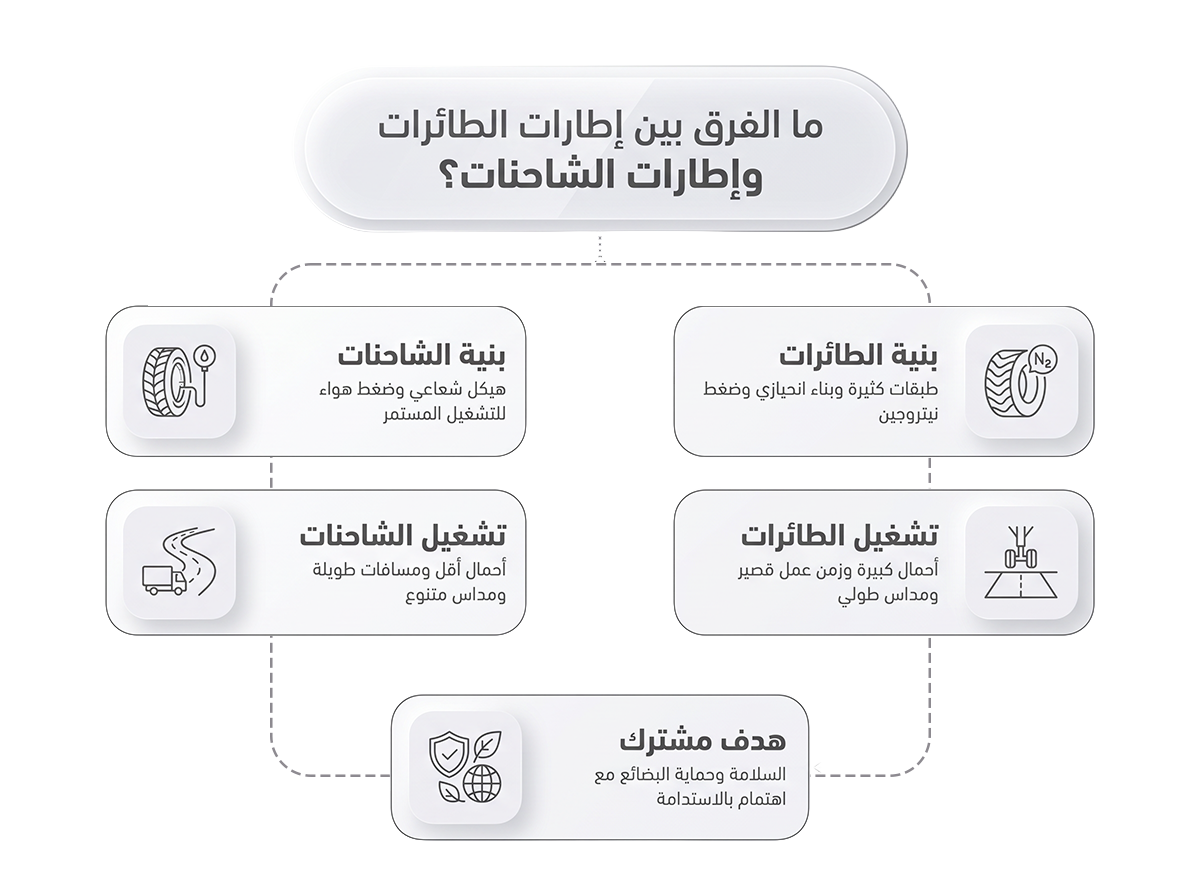
Designed for long-distance travel at moderate speeds, these tires focus on durability, stability, and load-bearing capacity on both paved and unpaved roads. Their inflation pressure ranges between 80 and 100 psi, and they are engineered to reach thermal equilibrium during continuous operation.
The Difference Between Aircraft Tires and Truck Tires
First: Internal Construction and Ply Count
- Aircraft Tire Structure
Aircraft tires are constructed from over 20 layers of overlapping materials, including a complex blend of high-strength synthetic rubber, nylon fibers, and woven steel wires.
These materials are arranged in a precise configuration where fabric layers intersect at alternating angles to provide the tire with exceptional strength that resists deformation under massive loads, while maintaining enough flexibility to absorb landing impacts. Additionally, cords of nylon or a synthetic polymer known as Aramid are embedded in the rubber to provide the tire with immense load-bearing capacity.
- Truck Tire Structure
Truck tires primarily rely on a radial structure, where fabric layers extend perpendicularly to the direction of travel. This design provides sidewall flexibility and better cooling capacity, which extends the tire's lifespan during continuous use. While truck tires may contain several reinforcement layers, their count does not approach the twenty layers found in aircraft tires.
"Aircraft tire pressure reaches 200 psi, which is double that of truck tires and six times that of car tires."
Second: Inflation Pressure
- Aircraft Tire Inflation Pressure
If there is one figure that summarizes the difference between aircraft tires and truck tires, it is inflation pressure. Commercial aircraft tires are inflated to approximately 200 psi, which is double the pressure of truck tires (ranging from 80-100 psi) and about six times the pressure of car tires (30-40 psi).
In some military aircraft, pressure can reach 320 psi or more. This extremely high pressure gives the tire its rigidity and ability to support the aircraft's immense weight without excessive deformation.
The high inflation pressure of aircraft tires is necessary because each tire must support a weight of up to 38 tons, compared to only 5 tons for a truck tire. This high pressure reduces tire deformation under load and prevents the buildup of excess heat that could lead to tire failure.
Third: Inflation Gas
The difference between aircraft tires and truck tires is not limited to pressure; it also includes the type of gas used. Aircraft tires are inflated with nitrogen rather than regular air.
Aircraft tires rely on inert nitrogen gas due to its unique properties, which ensure the highest levels of safety and durability in harsh operating environments.
Nitrogen possesses nitrogen high thermal stability, making it resistant to expansion and contraction compared to regular air. This is crucial for withstanding the extreme temperature fluctuations tires are exposed to, ranging from the freezing -60°C at high altitudes to the 150°C heat generated by heavy braking.
Furthermore, nitrogen helps extend the tire's lifespan and protects its internal components from corrosion, thanks to its non-reactive nature that prevents the oxidation of rubber and metal. The most important advantage remains safety; since nitrogen is non-flammable, it eliminates the risk of tire explosions or fires if temperatures reach abnormal levels.
In contrast, truck tires rely on regular compressed air, which is the most practical and economical choice for a less harsh operating environment. While truck tires must endure constant long-distance travel, they do not experience the extreme thermal shocks or sudden friction forces that necessitate the use of specialized gases like nitrogen.
"While truck tires are inflated with regular compressed air, aircraft tires rely on inert nitrogen gas, which provides superior thermal stability against temperatures ranging from -60°C to 150°C."
Fourth: Tread Design
If you look at an aircraft tire, you will immediately notice that its tread design consists only of straight longitudinal grooves, without any lateral grooves or complex blocks. There are precise engineering reasons for this:
- The longitudinal groove design is intended to channel water and prevent hydroplaning when landing on wet runways.
- Aircraft tires do not require significant lateral traction because the aircraft travels in a straight line on the runway. Consequently, simple grooves reduce excess friction that could generate destructive heat.
- The simple design helps dissipate the heat generated during friction with the runway.
In contrast, truck tires feature complex tread designs that include longitudinal and lateral grooves, as well as various blocks, to provide:
- excellent traction on various types of roads.
- Lateral stability during turns.
- Adaptability to rough roads and various weather conditions.
Fifth: Load Capacity
Take the Boeing 777 as an example, which has a maximum takeoff weight of over 300 tons. This massive weight is distributed across just 12 tires on the main landing gear, meaning each tire supports approximately 25 tons!
Furthermore, the aircraft lands at speeds exceeding 200 km/h, which adds immense impact forces to the static weight. Consequently, aircraft tires must be designed to withstand these forces during short, intermittent periods of use.
Truck tires, on the other hand, are designed to handle weights ranging from 700 kg to 150 tons for the entire truck, distributed across 18 or more tires. The difference here is that truck tires operate for continuous hours over thousands of kilometers, whereas an aircraft tire is only in use for a few minutes per flight.
Sixth: Electrical Conductivity
The difference between aircraft tires and truck tires also includes electrical properties, as aircraft tires are manufactured to be electrically conductive.
The reason for this is that during flight, an aircraft rubs against air particles, causing static electricity to accumulate on its fuselage. Upon landing, the conductive tires act as a safe path to discharge this electricity into the ground, preventing sparks that could be dangerous during refueling or maintenance operations.
Truck tires are typically electrical insulators, which is appropriate since cars and trucks do not experience static charge buildup to the same degree.
Seventh: Lifespan
The lifespan of an aircraft tire is not measured in kilometers, but in the number of landings. An aircraft tire can land approximately 500 times before needing a tread retread, and a tire can be retreaded up to 7 times during its service life, bringing the total number of landings to about 4,000.
The lifespan of truck tires is measured in kilometers and can last for tens of thousands of kilometers before replacement, depending on the quality of the tire, road type, and operating conditions.
Eighth: Safety Testing
Aircraft tires undergo much more rigorous safety testing than truck tires, as an aircraft tire must be capable of withstanding pressure equivalent to six times that of car tires.
While truck tires are also subject to strict safety standards, they do not approach the level of testing performed on aircraft tires, given the differences in operating conditions and risks.
Ninth: Safety Mechanism
Aircraft tires possess a unique safety feature: the fusible plug, a hollow bolt filled with a fusible metal that melts at a temperature of approximately 150 degrees Celsius.
During heavy braking, the tire temperature rises significantly. If the heat exceeds a safe limit, the metal inside the plug melts, allowing the gas to leak out gradually and safely, preventing the tire from exploding. Truck tires do not have this system, as sudden overheating conditions are less common in their typical use.
"Aircraft tire safety is ensured by the fusible plug, which melts at 150°C to safely release gas and prevent explosions."
The difference between aircraft tires and truck tires in terms of recycling
Specialized companies strive to protect the planet by converting tires into practical materials, innovating in recycling using advanced systems, supporting local communities by reducing illegal dumping and promoting responsible practices, and adhering to environmental regulations to help businesses and municipalities achieve their sustainability goals.
These companies accept all types of tires regardless of size or type, including car and bicycle tires, service trucks and forklifts, and even tires for aircraft, tractors, harvesters, and construction and rescue machinery.
Old tires are converted into a wide range of practical products, most notably: crumb rubber, rubber mulch, mats, shoe soles, sound barriers, rubberized asphalt, roofing shingles, thermal and acoustic insulation, playground surfaces, garden furniture, flower pots, and even tire-derived fuel, among others.
In conclusion,we recognize that the difference between aircraft tires and truck tires lies in their technical specifications, representing two distinct engineering philosophies:
Aircraft tires are engineering masterpieces designed for intense, short-term performance under the harshest conditions: extreme speeds, massive loads, drastic temperature fluctuations, and non-negotiable safety requirements. Every layer, nylon cord, tread groove, and pound of inflation pressure is calculated with absolute precision to ensure a safe flight.
Truck tires, on the other hand, are designed for reliability, economy, and long-distance durability, balancing strength, cost, and service life to keep the wheels of the economy turning.
Despite these differences, both types share a noble goal: protecting lives and property. Whether you are a passenger on a plane at 30,000 feet or a truck driver on a highway, the tires carrying you are the result of decades of research, development, and rigorous testing.
This confirms that choosing the right tire is not just a minor technical detail, but a fundamental factor for the safety of your journey and the efficiency of your business. In the world of heavy transport, your truck needs the durability to cover thousands of miles without compromising on safety or operational economy.
"The difference between aircraft tires and truck tires remains a model of engineering genius; the former is designed for extraordinary performance in brief moments, while the latter is perfected for economic endurance over long distances, both united by the single goal of safeguarding lives and property."
We invite you now to get the best truck tires certified by Darbak, andcontact our experts to determine the optimal choice based on your requirements and needs, with the highest quality standards and the best prices.