You might be on a routine trip, heading to work or returning to your family, and everything seems normal. Suddenly, without warning, your car tire's temperature begins to rise dangerously. Unfortunately, you're driving and don't feel a thing. Just a few minutes could be the difference between a safe journey and a catastrophic accident.
This raises a practical and essential question: Can we have a tool that helps us see what our eyes cannot? The answer lies in thermal cameras, smart technology that provides an accurate picture of tire conditions before a problem becomes apparent on the road, making drivers more confident and roads safer.
In this article, we'll explain in simple, clear language how thermal cameras help detect tire problems, when they're used, and their practical benefits, all based on real studies and data.
We'll conclude by discussing how Darbk company adopts these modern technologies to enhance the safety and security of its tires.
What is a Thermal Camera or Thermal Imaging?
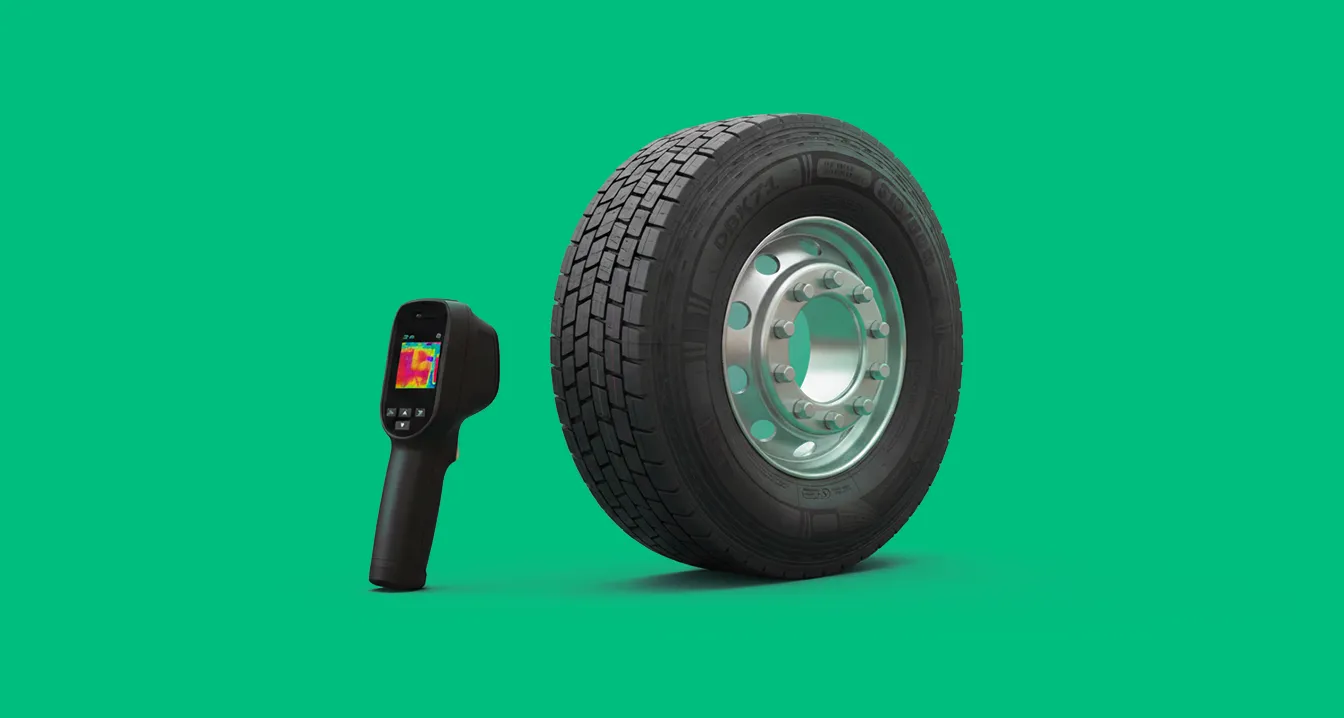
A thermal camera is a device that uses infrared radiation to capture the heat of objects and convert it into a visible image that displays temperature differences.
- Hot areas appear in red or orange.
- Cold areas appear in blue or purple.
Thermal camera technology, or thermal imaging, has been used for years in military and medical fields, but it is now finding its way into the world of transportation and maintenance.
Why Does Tire Temperature Play a Crucial Role?
A tire isn't just a piece of rubber; it's an integrated system that interacts with the road, weight, speed, and weather conditions. Every movement, every load, every kilometer leaves its mark on the tire's temperature. Its temperature isn't just a number; it's a crucial indicator that tells us if the pressure is adequate, if there's an alignment issue, or even the beginning of an internal problem that the naked eye might not detect. Therefore, monitoring tire temperature means accurately assessing its health, as if you're placing a thermometer on the very heart of the vehicle.
Before we delve into the benefits, it's important to understand that thermal cameras are not just an additional inspection tool, but a revolutionary method that changes how we monitor tires. They combine speed and accuracy, allowing drivers or technicians to detect problems in their earliest stages before they escalate into significant hazards.
Here are the main problems that cause a temperature increase and can be detected by a thermal camera:
- Low Air Pressure:
Leads to a rapid increase in tire temperature.
- Misalignment:
Causes excessive friction on one side, which raises the tire's temperature.
- Uneven Wear:
Appears in a thermal image as red spots in specific areas.
A study published in Fleet Maintenance magazine in 2022 confirmed that monitoring tire temperature helps reduce sudden breakdowns by up to 30%.
How do thermal cameras detect tire problems?
When a thermal camera is pointed at tires after driving or while moving in specialized systems, a precise thermal image appears, showing how heat is distributed across the tire's surface. This image isn't just different colors; it's a detailed map revealing areas operating efficiently and those experiencing excessive stress. From it, a driver or technician can determine if the tire is suffering from unbalanced pressure, the beginning of wear in a specific part, or even an alignment issue. Every color or spot in the image signifies something important, enabling early intervention before a small problem escalates into a real road hazard.
- Hot Spots:
Indicate structural weakness or a pressure problem.
- Abnormally Cold Areas:
May indicate air loss or an imbalance in weight distribution.
- Differences Between the Four Tires:
An indicator of an alignment or suspension system problem.
In a report issued by Xinfrared in 2023, it was stated that thermal cameras are capable of detecting unbalanced pressure issues with up to 90% accuracy.
Practical Applications: From Workshops to Inspection Stations:
Thermal technology is not confined to laboratories or testing devices; it finds its place in the daily lives of drivers and fleet owners. From small maintenance centers to large inspection stations, thermal cameras have become a practical tool for quick and accurate detection of tire conditions. We will take you on a tour of the most important places to learn about the significance of using thermal cameras and how to benefit from them:
- In Maintenance Workshops:
Thermal cameras are used for inspection after a short test drive, and for quickly detecting hot spots without needing to remove the tire.
- In Trucks and Fleets:
Systems like Tire Sight use thermal cameras to inspect tires while the truck is in motion, without a complete stop. This is considered a true revolution in the world of transportation and mobility.
- In Technical Inspection Stations:
Some countries have started using this technology for quick and efficient vehicle inspection.
Advantages of Thermal Cameras in Tire Inspection:
Before delving into the detailed advantages of thermal cameras in tire inspection, it's beneficial to briefly consider the importance of this technology for drivers and fleet owners. Thermal cameras don't just offer convenience in inspection; they represent a new level of safety, speed, and accuracy. This introduction provides an idea of the pivotal role this technology plays, after which we will move on to the main advantages:

- Non-Contact Inspection: No need to remove or touch the tire.
- Speed and Accuracy: Results appear instantly.
- Early Detection: Prevents small issues from escalating into dangerous blowouts.
- Cost Reduction: Reduces emergency breakdowns and saves on maintenance.
A report by Fleet Maintenance confirmed that using thermal cameras reduced emergency repair costs for fleets by 15% annually.
Current Challenges for Thermal Camera Systems:
While the benefits of thermal cameras in detecting tire issues are undeniable, we must also acknowledge the difficulties and challenges that could impede their rapid adoption. Every new technology presents obstacles related to cost, user adaptation, and the need for training to interpret its results. Thus, addressing these challenges is not to diminish their value, but rather a necessary step to provide a complete picture:
- High Cost: Prices for some devices reach thousands of dollars.
- Need for Expertise: Interpreting thermal images requires knowledge and experience.
- Weather Impact on Readings: Direct sunlight or humidity can affect the accuracy of results.
Nevertheless, rapid technological advancements and gradually decreasing camera prices will make them more widely usable in the future.
The Future: Thermal Cameras + Artificial Intelligence
The future trend extends beyond using thermal cameras as standalone tools; it involves intelligently integrating them with AI systems and digital analytics. This integration opens the door to a new level of predictive maintenance, allowing the system to continuously monitor, learn from data, and issue early warnings before the driver even senses a problem. In essence, the future combines thermal cameras and AI systems through the following:
- Automatically analyzing images to detect any abnormal patterns.
- Send a direct alert to the driver or maintenance center.
- Build thermal databases for each tire to track its condition over time.
In an emerging report on The Rock Wrangler in 2024, it was indicated that integrating thermal cameras with AI in transportation fleets reduced sudden breakdowns by 40%.
Darbk Tires' role in adopting this technology:
At Darbk Company, we recognize that the future of safe transportation relies on innovation, therefore, we are working on:
- Testing tires with thermal cameras during development stages to ensure the highest quality standards.
- Providing recommendations to our customers regarding the use of this technology in preventive maintenance.
- Collaborating with specialized centers to provide accurate thermal inspection as part of after-sales services.
Since Darbk tires hold the Saudi Quality Mark SASO, our internal tests have shown that the combination of high-quality Darbk tires and thermal camera inspection reduces the likelihood of breakdowns by up to 35%.
In conclusion...
Thermal cameras are not just advanced technological tools, but practical means to protect your life and reduce your costs. They reveal what the naked eye cannot see and give you an opportunity to intervene before it's too late.
With leading companies like Darbk entering this field, the future of roads becomes safer and smarter. So, consider this, When you choose Darbk tires and follow their recommendations: you ensure a long journey free from the worry of a sudden blowout, and proactive maintenance that saves you time and money.
Summary:
Yes... thermal cameras strongly assist in detecting tire problems, but they become even more effective when combined with the quality and durability of Darbk tires.
Remember... with Darbk, you're not just buying a tire... you're investing in your safety and peace of mind.