One of the biggest challenges for any driver's budget is knowing how to save on tire costs, especially since they are among the most frequent and expensive maintenance items.
You may find yourself forced to replace the entire set of tires every two to three years, with an average lifespan ranging from 40,000 to 60,000 kilometers, which costs you thousands of riyals or dirhams.
However, you can cut this cost in half annually by adopting smart and proper maintenance and daily care practices.
Let’s explore the best practical and proven strategies that will ensure you extend the life of your car tires without compromising your safety or vehicle performance on the road.
"You can cut your annual tire costs in half by adopting smart and proper maintenance and daily care practices, without compromising your safety or vehicle performance."
Why are tires so expensive?
Tires are a significant financial burden because they are the product of complex engineering, relying on advanced technologies and high-quality composite materials developed to ensure stability and safety in various weather conditions.
The global market for investment in this sector is witnessing steady growth that reflects increasing demand, alongside rising costs for research, development, manufacturing, and testing.
When looking at any vehicle's operating budget, equipping the car with a new, high-quality set of tires represents a significant financial investment. However, frequent replacements due to rapid wear turn this into a recurring burden that impacts a driver's cash flow. Therefore, adopting smart practices to extend tire life is a highly effective economic solution that prevents financial waste and maximizes the value of this investment.
The importance of tire pressure, and how to make the most of it?
Tire maintenance experts emphasize that maintaining the correct tire pressure is the most important step you can take to save on tire costs. Under-inflating tires increases rolling resistance, forcing the engine to work harder and consume more fuel. Conversely, proper air pressure extends tire life by approximately 7,500 kilometers.
Therefore, it is always recommended to check the pressure at least once a month. It is best to do this when the tires are cold—meaning the car has not been used for at least three hours—using the recommended pressure found on the tire and loading information sticker on the driver's door jamb or in the owner's manual.
"Checking your tire pressure monthly when the tires are cold is the simplest investment that will save you significant amounts of money."
Tire rotation and its importance in cost savings
Tire rotation means regularly changing the positions of the tires on the vehicle according to a specific pattern to ensure they wear evenly. This is essential because, in front-wheel-drive cars, the front tires wear out faster than the rear ones due to the weight of the engine and the forces of steering and acceleration. Without regular rotation, you will need to replace the front tires long before the rear ones, leading to more frequent tire purchases.
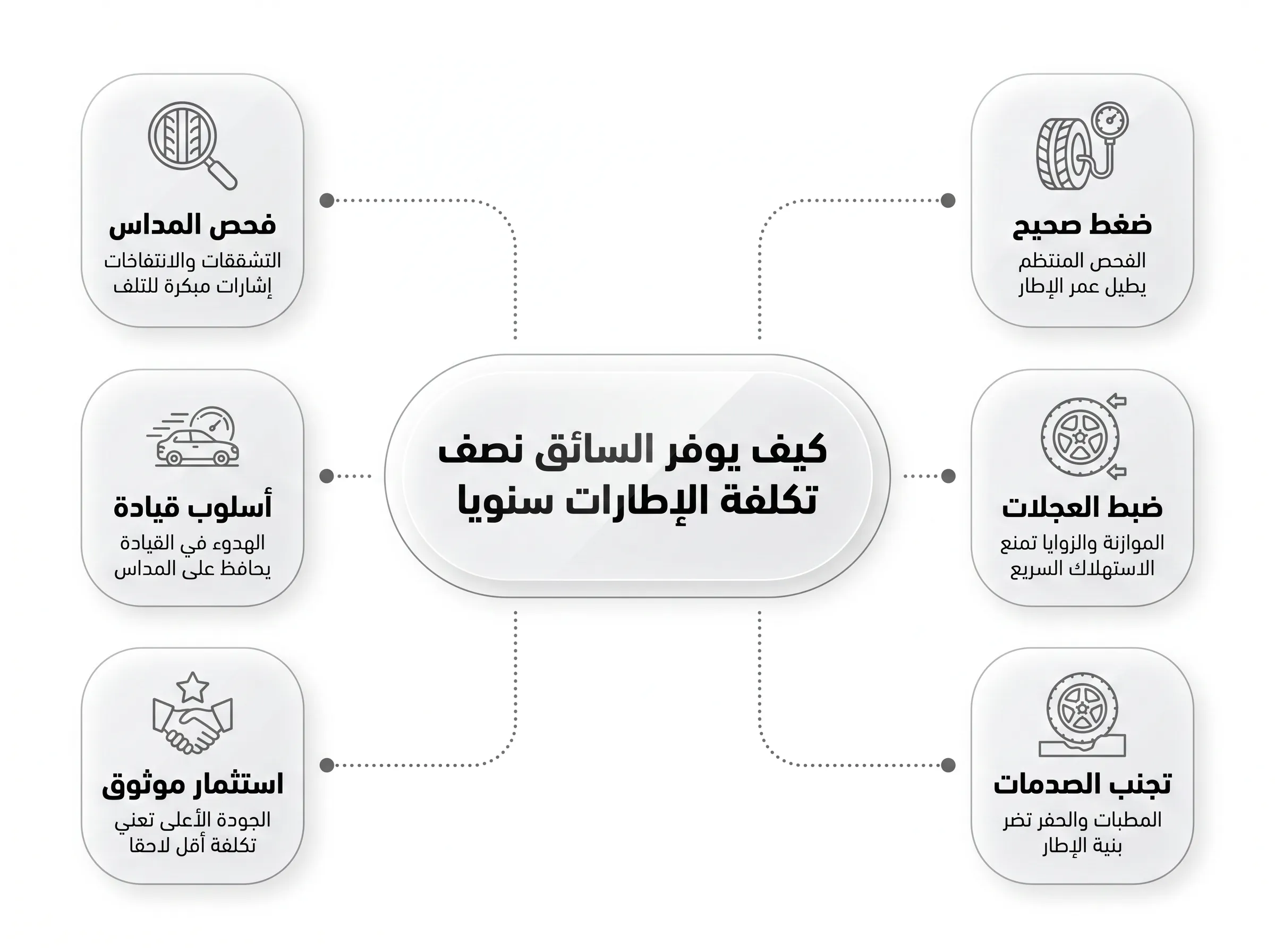
It is recommended to rotate your tires every 8,000 to 10,000 kilometers. Rotation patterns vary depending on the vehicle type—whether it is front-wheel drive, rear-wheel drive, or all-wheel drive—so it is best to check your owner's manual for the appropriate pattern.
"Rotating your tires every 8,000 to 10,000 kilometers ensures even wear across all tires, prevents the need to replace front tires before rear ones, and reduces the number of annual purchases."
Wheel alignment and balancing
Wheel alignment ensures that all tires make contact with the road at the correct angle. It also prevents uneven tire wear, improves vehicle handling and steering performance, and contributes significantly to extending the life of your tires.
Wheel balancing refers to the even distribution of weight around the wheel axle to prevent vehicle vibrations, especially at high speeds, which can otherwise lead to rapid and uneven tire wear.
It is always recommended to balance your tires every 8,000 to 12,000 kilometers or every six months, as well as whenever new tires are installed.
Tire Valves
Tire valves directly impact tire costs, as their primary function is to regulate airflow and maintain internal pressure to prevent leaks.
Valves can become damaged when exposed to excessive dirt, dust, and weather conditions, causing slow air leaks that may not be immediately noticeable. This leads to a gradual drop in tire pressure, which increases rolling resistance and fuel consumption, causes uneven tire wear, and can even lead to sudden valve failure while driving, potentially causing a tire blowout.
We recommend replacing tire valves whenever you install new tires, or at least every two to three years. You should also check the valve cap to ensure it is tight, as it protects the valve from dirt and moisture. This small investment saves you the cost of replacing an entire tire due to air leaks and uneven wear.
Tire Lifespan
Many people mistakenly believe that a tire is safe to use as long as the tread is not worn out, but the truth is that tires have a limited lifespan regardless of the distance driven. Most manufacturers recommend not using a tire for more than 5 to 6 years, even if it hasn't been used, because rubber materials degrade and are affected by aging in ways that are not visible to the naked eye.
Therefore, you should check the manufacturing date printed on the tire sidewall and calculate its age. If it exceeds five years, start planning for a replacement, even if it appears to be in good condition.
Driving Habits and Their Role in Saving Tire Costs
Your driving style directly affects the life of your tires. Aggressive driving is undoubtedly the number one enemy of tires; therefore, you should avoid sudden acceleration and hard braking, as these are primary causes of rapid tread wear and excessive heat buildup in tires.
You should also avoid driving at high speeds, as this increases friction and tire temperature, leading to rapid wear and a reduced lifespan. Likewise, sharp cornering causes localized wear on the tire sidewalls.
"Aggressive driving is the number one enemy of tires; avoiding sudden acceleration, hard braking, and sharp cornering will double the tire's lifespan and save you the cost of premature replacement."
Choosing the Right Tires: A Long-Term Investment
Cheap tires may seem tempting at first, but they are often less durable and wear out faster. Therefore, buying tires from well-known and trusted brands is an investment that saves on tire costs in the long run.
As for purchasing budget tires, they are manufactured using less expensive technologies and raw materials compared to premium brands. While they may be a suitable option for a limited budget, their lifespan is often shorter.
Experts recommend finding a balance between price and quality, choosing tires that suit your vehicle type and driving conditions, while reviewing performance ratings and expected lifespan.
Periodic Inspection and Preventive Maintenance
You can perform periodic inspection and preventive maintenance on your tires by following these guidelines:
- Inspect the tire tread for punctures or uneven wear, check the sidewalls for cracks or bulges, and replace the tire immediately if the tread depth falls below 1.6 mm.
- Check tire pressure monthly and before long trips to match the owner's manual, which helps avoid uneven wear, ensures fuel efficiency, and prevents tire blowouts caused by heat.
- Rotate your tires to ensure friction and wear are distributed evenly.
- Align your wheels to ensure they track in a straight line, especially if you notice the vehicle pulling to one side after hitting a curb or pothole.
- Balance your tires to redistribute weight evenly around the wheel, preventing vibrations while driving and protecting suspension components from damage.
- Periodically check the spare tire's pressure and condition to ensure it is free from age-related damage and ready for emergencies.
- Avoid exceeding the maximum load capacity, adhere to the tire's speed rating, and avoid harsh impacts with speed bumps and potholes.
Additional Tips to Save on Tire Costs
Beyond meeting safety standards, maintaining your tires is a smart decision that saves you money. With a little daily attention and good habits, you can extend the life of your tires and avoid premature replacement. Here are the most important additional tips to help you save on tire costs:
- Avoid Direct Sunlight
In hot climates, tires are exposed to ultraviolet rays that cause the rubber to dry out and crack, so try to park your car in the shade or use tire covers.
- Be Aware of Heat's Effect on Pressure
Heat increases air pressure inside tires, and you may need to adjust the pressure more frequently during the summer. We recommend checking the pressure in the morning when the tires are cool to get an accurate reading.
- Don't Neglect the Spare Tire
Don't forget to check the spare tire's pressure as well, as you will need a tire ready for use in an emergency.
- Consult Professionals
Consult a professional tire technician if you suspect any issues, as periodic inspections can reveal problems that are not visible to the naked eye.
- Avoid improper seasonal tire storage
If you switch between summer and winter tires, be sure to store the unused set in a cool, dry place away from chemicals or oils that could break down the rubber compounds.
- Clean gravel from tire treads
Small stones and sharp gravel often get stuck in tire treads. If left unattended, the rotation of the wheel and the weight of the vehicle can drive them deeper, potentially causing punctures or damaging the tire's internal steel belts.
- Avoid overloading your vehicle
Always adhere to the maximum weight limit listed on the driver's door sticker or the tire sidewall. Excess weight puts immense pressure on the tire structure, increasing heat and accelerating wear or the risk of a blowout.
- Invest in energy-efficient tires
Look for tires designed to reduce rolling resistance; these last longer and can save you a significant amount on your monthly fuel bill.
- Avoid hitting curbs when parking
Scraping your tires against curbs while parking can cause cuts to the sidewall or lead to "bubbles." These are serious, irreparable defects that force you to replace the tire immediately, even if it is brand new.
Choosing tires that combine high quality with longevity is an investment, not an expense. Budget tires might save you money today, but they will cost you much more tomorrow due to frequent replacements.
In conclusion, the most important question remains: where can you find tires that combine high quality and long life at a competitive price?
You can rely on Darbak , the first Saudi tire brand to receive the Saudi Quality Mark from the Saudi Standards, Metrology and Quality Organization (SASO). Their tires are specifically designed to withstand the harsh, hot climate of the Gulf region and have been tested to exceed over 50 international standards to ensure the highest levels of performance and safety.
The company provides exactly what you are looking for: long-lasting tires that save you money and give you peace of mind on the road, thanks to advanced technology that reduces rolling resistance and improves fuel efficiency.
Don't wait until it's time to replace your tires;visit our website now to discover our diverse range that meets all your needs, backed by a reliable one-year warranty on all our tires, reflecting our confidence in their durability and quality.