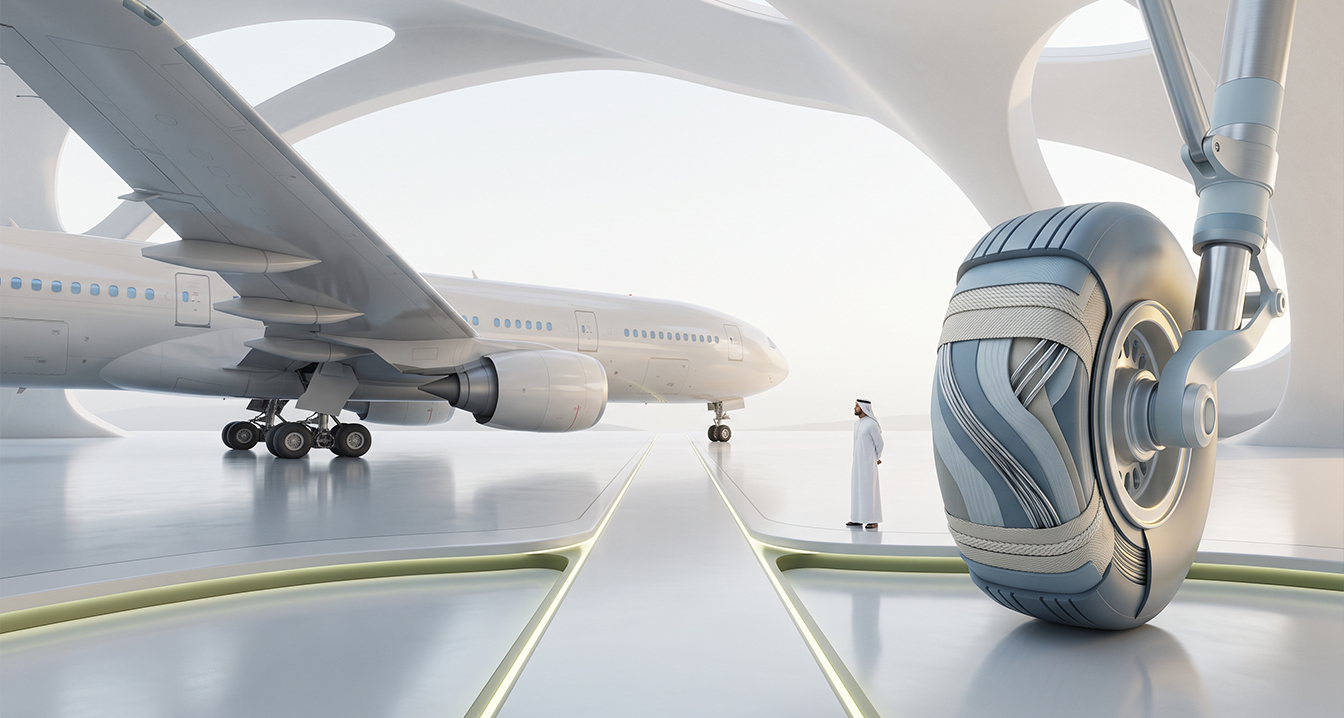
Aircraft tires are perhaps one of the greatest achievements of modern engineering, a fact made clear the moment a massive aircraft like a Boeing 747 or Airbus A380 touches down on the runway, highlighting the vital role these tires play in ensuring the safety of the entire operation.
Aircraft tires are engineered to allow landing gear systems to withstand weights exceeding hundreds of tons, speeds of up to 280 kilometers per hour, and extreme temperatures, all while maintaining the highest standards of safety and reliability.
How about we take you on an exciting journey to understand the secrets behind aircraft tire manufacturing, the advanced materials used in their composition, and the complex physics that allow them to endure such immense loads?
"Aircraft tires withstand internal pressure of up to 200 psi—more than six times the pressure of your standard car tires—to support a weight exceeding 30 tons per tire."
The Importance of Aircraft Tires in the Aviation Industry
It is fair to say that tires are among the most critical components of any aircraft; they are the link between this flying giant and the runway. Imagine a Boeing 777 weighing about 300 tons upon landing, with that massive mass distributed across just 12 tires in some configurations. This means each tire bears over 25 tons of weight, and some aircraft tires can handle more than 30 tons each.
But it is not just about weight; aircraft tires are subjected to unparalleled harsh conditions, most notably:
- Landing speeds exceeding 280 kilometers per hour.
- Temperatures ranging from -40°C to +70°C or higher.
- Inflation pressure reaching 200 psi in large commercial aircraft, rising to 320 psi in fighter jets—a pressure 6 to 7 times higher than that of car tires.
- Immense frictional forces during landing and braking.
So, how do these tires survive such extreme conditions? The answer lies in the advanced materials used and their unique engineering design.
Key Materials in Aircraft Tire Manufacturing
- Rubber
Rubber is the most prominent element in aircraft tires. A sophisticated blend of natural and synthetic rubber is used; natural rubber provides high elasticity and tear resistance, while synthetic rubber enhances durability and resistance to heat and wear.
Butadiene rubber is then added to improve resistance to the wear and tear caused by intense friction with the runway, and carbon black is used as a reinforcing filler to significantly increase the rubber's strength and rigidity.
In the final stage, the components are mixed with zinc oxides and sulfur—the elements responsible for the "vulcanization" or chemical bonding process that gives the rubber its final structural integrity and enables it to withstand harsh conditions.
- Nylon
Beneath the outer layer of rubber lies the internal structure of the aircraft tire, which consists primarily of multiple layers of nylon fibers. This material is lightweight yet extremely strong, distinguished by its ability to maintain its flexibility even under immense pressure.
Aircraft tires typically use more than 20 layers of interwoven nylon, laid in opposing, overlapping directions with precise engineering to enhance strength in all directions and distribute loads evenly. In commercial aircraft tires, this number can reach up to 38 layers.
- Kevlar
Kevlar is an ultra-strong synthetic polymer that is five times stronger than steel by weight. It features exceptional heat resistance up to 500°C, which is why it is incorporated into aircraft tire construction to enhance resistance to cuts and abrasion.
Some companies use advanced technology that combines Kevlar and nylon into single threads to enhance strength while simultaneously reducing weight. This technology also increases the resistance of aircraft tires to damage caused by foreign objects on the runway, which is one of the primary causes of tire incidents.
"A single wide-body aircraft tire contains more than 20 interwoven layers of nylon and Kevlar, stacked at opposing angles to distribute massive impact forces, acting like an unbreakable, flexible skeleton."
- Steel and Aluminum
Aircraft tires are reinforced with layers of steel or aluminum wires in specific areas, particularly in the tread belt (the part that touches the ground) and the bead area (which secures the tire to the wheel).
Some manufacturers also use aluminum beads instead of steel to save weight while maintaining strength and durability, thereby contributing to reducing the aircraft's overall weight and saving on fuel consumption.
A Deep Dive into "Polyamide 66 - Nylon 66": The Hidden Backbone
One of the essential materials in aircraft tire manufacturing is "Polyamide 66 - Nylon 66." It is not just an ordinary thread, but the product of precise chemical engineering. PA66 fibers are characterized by exceptional tensile strength, superior resistance to abrasion and heat, and the ability to absorb shocks—properties that enable aircraft tires to withstand massive rated loads and intense impact energies in high-heat environments.
However, these fibers face a challenge due to their low surface activity, which weakens their adhesion to the surrounding rubber. To address this, manufacturers use advanced techniques such as surface plasma treatment, which significantly improves the bond performance between PA66 fibers and the rubber, preventing separation and greatly enhancing tire durability. These fine details are what distinguish high-quality aircraft tires.
Why is nitrogen used in aircraft tires?
Aircraft tires are inflated with Nitrogen gas instead of regular air for reasons related to safety and efficiency, most notably:
- Preventing explosions during thermal rise, as nitrogen is a stable gas that is not affected by the extreme heat generated by tire friction with the runway during landing, thus maintaining pressure and preventing tire bursts.
- Protection against rust and corrosion, as nitrogen is used in a completely dry state free of water vapor, unlike regular air which can condense inside the tire and cause metal parts to rust.
- Extending rubber life, because nitrogen does not react with the tire's inner rubber and does not cause oxidation, thereby protecting the rubber from premature degradation.
- Maintaining tire pressure stability, as nitrogen is far less affected by weather and temperature changes than regular air, ensuring that pressure remains constant inside the tire under various flight conditions.
"Dry nitrogen is not just an alternative to air; it is a safety shield that prevents dangerous pressure fluctuations and protects the rubber from oxidation, making aircraft tires more capable of withstanding the instantaneous friction during landing."
Radial vs. Bias Tires
There are two main types of aircraft tires: radial and bias. The differences between them go beyond internal design, directly impacting performance and safety.
Research conducted by NASA has shown that radial tires provide exceptional weight savings, reducing weight by up to 20% compared to bias tires.
The secret lies in the radial tire's structure, where layers are placed perpendicular to the direction of travel and reinforced with protective fabric and steel belts. This unique design helps to:
- Dissipate heat quickly and reduce the heat generated by intense friction with the runway.
- Maintain tire balance and stability during movement.
- Add an extra rubber layer under the tread that increases wear resistance and withstands a greater number of flights.
Thanks to these engineering solutions, radial tires have become the primary choice for most modern commercial aircraft.
How do aircraft tires support weights of hundreds of tons?
The ability of aircraft tires to withstand such extreme loads lies in an exceptional engineering combination of robust structural design, high pressure, and advanced materials. Here is a breakdown:
- The Principle of Load Distribution
The primary secret to the ability of aircraft tires to support such massive weights lies in load distribution. For example, a Boeing 777 weighs 300 tons and does not rest on two or four tires, but on 12 tires distributed across several wheels; this distribution reduces the load on each individual tire.
However, even with this distribution, each tire on a large passenger aircraft supports loads of up to 20 tons or more, and the load capacity of a single tire can reach 38,000 kilograms in some military applications.
- The Role of High Pressure
Aircraft tires are inflated to very high pressures compared to car tires to give the tire enough rigidity to support the massive weight without deforming or compressing excessively upon contact with the ground. It is the same concept as an air-filled balloon: the higher the internal pressure, the greater its ability to support weight without compressing.
- Multi-Layer Design
As mentioned earlier, aircraft tires consist of more than 20 layers of reinforced materials that work together like a flexible skeleton, distributing compression and tension forces over a large area of material, which prevents stress from concentrating at a single point.
- Rigorous Testing
Before aircraft tires leave the factory, they undergo a series of rigorous tests that simulate real-world operating conditions, including:
- Static load tests to determine the maximum weight the tire can withstand.
- High-speed testing to simulate landings at speeds of up to 360 km/h.
- Extreme temperature testing ranging from -40°C to over 70°C.
- Foreign object penetration testing to simulate runway debris impact.
- Burst testing, where the tire must withstand pressure exceeding four times its normal operating pressure before failing.
"Before any tire leaves the factory, it is tested to withstand landing speeds exceeding 360 km/h and extreme temperatures ranging from -40°C to +70°C, ensuring it is ready for the harshest conditions."
The engineering behind the strength of aircraft tires despite their size
The strength of these tires relies primarily on the integration of synthetic fibers known as "Aramid," which is characterized by its extreme heat resistance; its melting point reaches 500°C, compared to regular rubber, which begins to melt at just 260°C.
Aramid fibers also provide the tire with immense resistance to wear and help it maintain its structural integrity, allowing a single tire to last for approximately 500 flights before needing replacement—a significant advantage given the complexity and difficulty of changing aircraft tires.
The technology does not stop at Aramid; it incorporates multiple engineering solutions that ensure the distribution of massive weights and the ability to withstand sudden pressure during landing. These innovative materials work together to ensure the tires operate with complete efficiency without bursting or wearing out prematurely.
"Despite their high cost and a lifespan limited to just 300 landings, aircraft tires are the primary guarantee of passenger safety thanks to their advanced engineering."
In conclusion, we observe the precision of aircraft tire engineering, which enables them to support weights of hundreds of tons, withstand speeds exceeding 280 km/h, and endure extreme temperatures while maintaining safety and reliability—a testament to the genius of the engineers and scientists who have designed and developed them over the decades.
The next time you watch a plane land, remember that what separates this metal giant from the runway is just a few centimeters of rubber reinforced by state-of-the-art technology, enabling aircraft tires to perform their task perfectly, flight after flight.
Finally, it is worth noting that Saudi Vision 2030 is opening promising horizons for localizing advanced aviation industries. Research centers and national companies can strengthen this sector by transferring modern technologies in tandem with the expansion of the Saudi aviation fleet, thereby enhancing industrial security, creating high-quality job opportunities, and supporting a sustainable knowledge-based economy.