
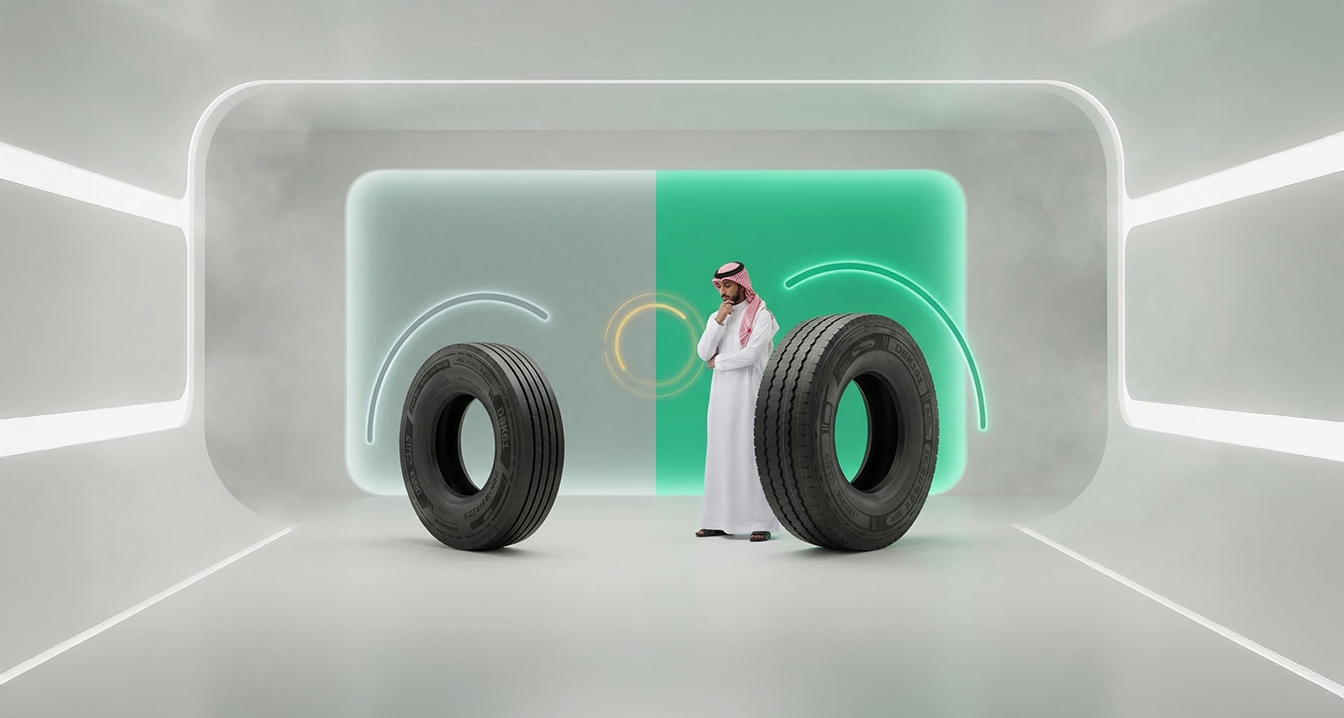
Truck drivers often ponder a question that seems simple on the surface but conceals complex technical details: Does a large tire make a truck faster? Or is a smaller tire better for performance? This question isn't solely about speed; it also concerns fuel efficiency, safety, tire lifespan, and even driver comfort.
In this article, we will break down this concept step by step, drawing on real studies and practical experiences. Ultimately, we will demonstrate how Darbk company provides a balanced solution that doesn't prioritize speed over safety, but instead delivers intelligent, long-lasting performance.
What do we generally mean by truck speed?
When we discuss truck speed, we're not merely referring to the number displayed on the speedometer or the maximum velocity a truck can achieve on a flat, empty road. In the trucking world, the concept of speed is far broader and deeper, as it's intrinsically linked to the realities of daily operations, heavy loads, varied road conditions, and time constraints.
Here, speed encompasses several interconnected dimensions:
- Maximum Speed:
This refers to the highest speed a truck can theoretically attain. While this figure might appear attractive on paper, it's rarely utilized in heavy trucks due to regulations, load considerations, and safety requirements.
- Acceleration:
This refers to a truck's ability to go from a standstill to its operating speed. This factor is critically important for trucks, especially when starting with a heavy load, merging onto highways, or ascending inclines. A truck with poor acceleration could waste more time, even if its maximum speed is higher.
- Practical Speed:
This is the most crucial aspect. It represents the truck's actual real-world performance, considering factors like load, frequent stops, inclines, traffic congestion, and road conditions. This is the speed a driver truly experiences, and it directly impacts trip duration and fuel consumption.
In many cases, a truck might appear faster on paper due to a higher maximum speed or specific technical specifications, yet in actual use, it proves slower, consumes more fuel, and offers less driver comfort. Therefore, a comprehensive understanding of what "speed" truly means is the first step in making an informed decision when selecting the appropriate tire.
The Fundamental Difference Between Large and Small Tires:
Before delving into technical specifics, it's crucial to establish a clear understanding of the core concept. Many drivers perceive tire size primarily based on appearance or general impression, but the actual difference runs much deeper. Tire size directly impacts wheel rotation, truck responsiveness, fuel consumption, and even the driving style itself. In this section, we will first clarify what constitutes a "large" or "small" tire and explain why performance cannot be judged by size alone.
What Do We Mean by a Large or Small Tire?
The distinction isn't solely about the tire's shape, but also its:
- Outer diameter.
- Tire width.
- Sidewall height.
A larger tire implies a greater diameter, which in turn means a longer distance covered with each single rotation.
Number of Revolutions and Distance
From a physical perspective:
- A larger tire covers a longer distance per revolution.
- A smaller tire requires more revolutions to cover the same distance.
However, this theoretical fact does not necessarily translate to better speed on the road.
Do larger tires make a truck faster?
This is the most common question among truck drivers, and it's often met with quick, brief answers that don't fully reflect the truth. While a larger tire gives an impression of power and speed, the technical reality is somewhat different. To understand the full picture, we need to distinguish between what happens theoretically on paper and what actually occurs on the road under daily load and stress.
- Theoretically:
Yes, a larger tire can increase top speed because:
- The engine's RPM decreases at the same speed.
- The truck covers a greater distance with each wheel revolution.
- In practice:
Here, the comparison changes almost entirely:
- A larger tire requires more energy to rotate.
- Reduced Acceleration especially when starting or climbing inclines.
- The load on the engine and transmission increases.
According to studies by Bridgestone Commercial Tires, increasing tire diameter by 10% can lead to a decrease in acceleration by up to 8% in heavy-duty trucks.
Do smaller tires make a truck slower?
After reviewing the impact of larger tires, it's time to consider smaller tires, which are often misunderstood. Many drivers associate smaller tire sizes with poor performance or slowness, but practical experience reveals a completely different picture.
In fact, smaller tires can be an asset in certain situations, especially when it comes to acceleration, handling, and navigating challenging roads. To understand this clearly, we'll begin by comparing the impact of smaller tires on acceleration versus top speed.
- Acceleration vs. Top Speed:
Smaller tires provide:
- Better acceleration.
- Faster engine response.
- Stronger performance during takeoff or on mountainous roads.
However: Top speed may be lower compared to larger tires.
- Handling and Stability:
Smaller tires often provide:
- Better control in congested traffic.
- Greater stability during braking.
This is a very important factor for truck safety.
The Impact of Tire Size on Fuel Consumption:
According to the U.S. Department of Energy, choosing an inappropriate tire size can increase fuel consumption in trucks by up to 6%.
Fuel consumption is the biggest concern for every truck driver, as it directly impacts monthly profits. Any slight increase in consumption eventually turns into a significant cost, especially for trucks that travel thousands of kilometers each month.
And tire size plays a fundamental role in this aspect:
- A larger tire often has higher rolling resistance, meaning it requires more energy to start and maintain motion, especially during acceleration or on uneven roads.
- An unsuitable tire for the truck's specifications can force the engine to operate outside its optimal range, leading to higher fuel consumption without a real benefit in performance.
- An ill-considered change in tire size can affect the transmission, causing the engine's RPMs to be either too high or too low, both of which increase consumption.
When we talk about a truck that travels tens of thousands of kilometers annually, this percentage translates to hundreds or even thousands of liters of unnecessarily wasted fuel.
Impact of tire size on safety:
- Braking distance:
- A larger tire doesn't always mean better braking.
- The quality of the rubber and the tread pattern are more important than size alone.
- Stability at high speeds:
- The appropriate tire width plays a greater role than the diameter.
- The balance between size and tread is key to safety.
According to NHTSA reports, tires that do not comply with manufacturer recommendations significantly increase the risk of losing control.
What do truck manufacturers say?
Companies like Volvo, Trucks, and Scania emphasize a fundamental and undeniable point: tire size is not chosen randomly.
The tire size is part of an integrated engineering system upon which the truck was designed by the manufacturer. This size is directly linked to several vital systems within the truck, most notably:
- Gearbox:
Changing the tire diameter affects the actual gear ratios, which can cause the engine to operate outside its optimal range, either with higher effort or lower efficiency.
- Differential:
The differential is programmed and designed to handle a specific number of wheel rotations. Changing the size can cause additional stress on it and reduce its lifespan.
- Suspension System:
Tire size and weight affect load distribution and shock absorption, and any ill-considered change could result in additional vibrations and faster wear of suspension components.
For this reason, manufacturers warn against modifying tire size without consulting the approved specifications, because any uncalculated change could lead to higher fuel consumption, unbalanced performance, and costly mechanical failures in the medium and long term.
Which is best for heavy trucks?
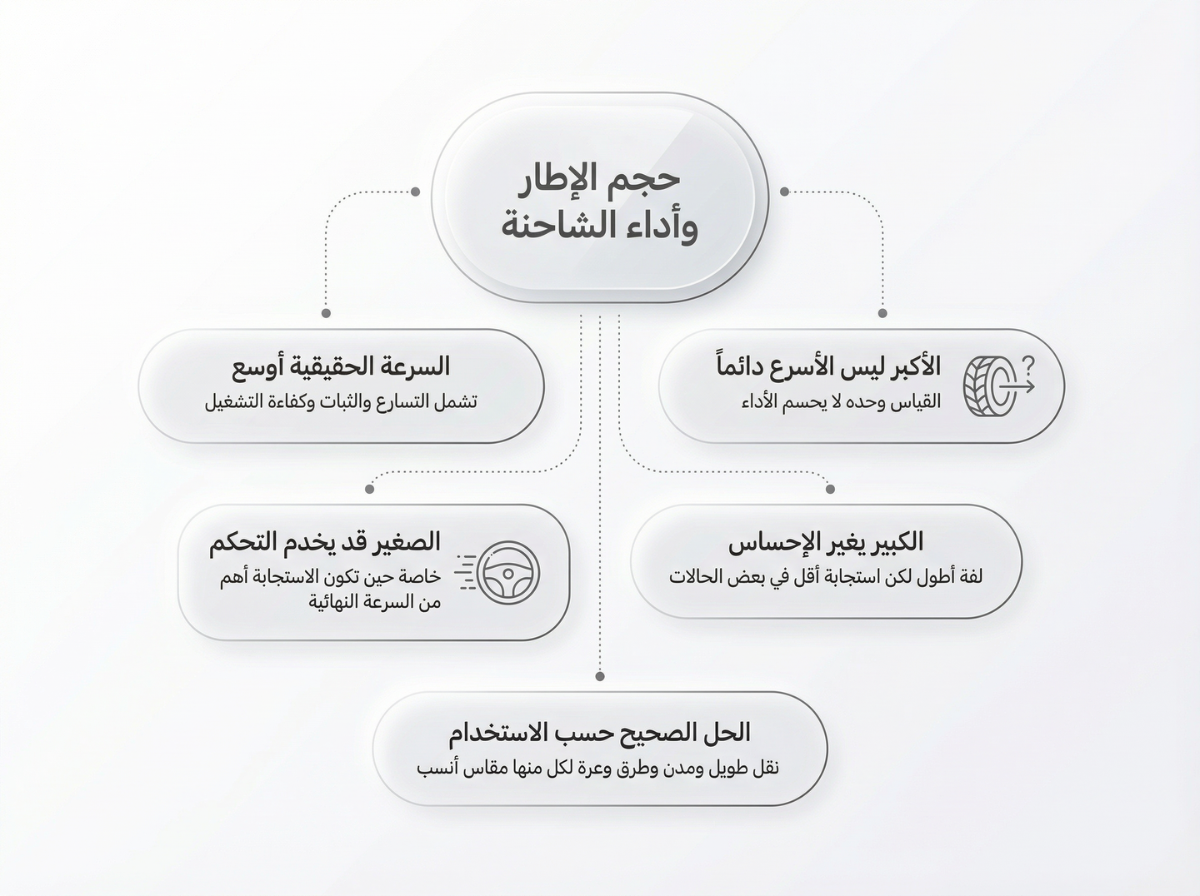
There is no single "fastest" tire that can be universally applied to all trucks and all operating conditions. True performance is not measured by size alone, but by how well the tire matches the truck's daily operational nature. What might be an excellent choice for one truck could be completely unsuitable for another with different loads, routes, or operating patterns.
The correct tire size selection depends on a set of interrelated factors, the most important of which are:
- Load Type:
Trucks that consistently carry heavy loads require tires that can withstand pressure and distribute weight efficiently, even if it means sacrificing some theoretical speed. In this case, stability and lifespan are more important than achieving higher speeds.
- Road Type:
Driving on flat highways is completely different from driving on mountainous roads or within cities. Highways rely on balanced tires that reduce fuel consumption, whereas winding or rough roads require tires that provide better control and responsiveness.
- Distances Traveled:
Trucks that cover long distances daily therefore need tires designed for stability and fuel economy, because any small difference in consumption multiplies over time. As for trucks with short distances and frequent stops, they often benefit from tires that provide better acceleration and quicker response.
In other words... true speed in the world of trucks is not a fixed number, but rather the result of a smart choice that balances performance, safety, and operational cost.
Examples:
- Long-Haul Trucks: They require a balance between size and economy.
- City Trucks: A smaller tire is generally the most suitable for use.
- Rough Roads: A well-considered size and tread pattern are more important than speed.
How does Darbk provide the smart solution?
At Darbk, we don't just see the tire as a means to speed, but as an integral component of the truck's performance. That's why we offer our customers the following:
- Tires designed with sizes carefully considered for heavy truck use.
- An ideal balance between diameter, width, and rolling resistance.
- Technologies that reduce fuel consumption while maintaining acceleration.
- Complete adherence to Saudi quality and safety standards.
With Darbk, don't just seek speed... but smart performance that protects and serves you for years.
A large tire isn't always faster, and a small tire isn't necessarily slower. True speed in the trucking world is a balance of performance, safety, and economy.
When you choose the right tire for your needs and trust a brand like Darbk, you don't just save time; you also reduce breakdowns, risks, and costs.
And remember that speed isn't about size, but about making a smart choice.


