

What should you know about the Emergency Brake Assist function? When driving on a busy road and forced to make a sudden stop for any reason, your natural reaction is to press the brake pedal. However, you might still not be able to avoid a collision. This is where Emergency Brake Assist technology plays its role.
This advanced technological system helps mitigate human errors, which are the primary cause of most traffic accidents worldwide. It monitors the road and reacts at lightning speed when it detects a potential threat.
So, what is the nature of this system's operation? And how exactly does it work to protect us and those around us? Below, we will explore the function of Emergency Brake Assist and how it enhances road safety.
"The Emergency Brake Assist system reacts at lightning speed upon detecting a threat, complementing the human driver's reaction and helping them avoid or mitigate a collision in critical moments."
What is the Emergency Brake Assist System and How Does It Work?
The Emergency Brake Assist (BAS) system relies on an intelligent mechanism to optimize braking response in critical situations. It continuously monitors the speed and force of the driver's pressure on the brake pedal. When the electronic control unit detects a rapid and sudden pressure pattern indicating an emergency, such as an attempt at a sudden stop, it automatically activates the brake booster to maximize braking pressure, regardless of how hard the driver presses the pedal.
Key Components of the Emergency Brake Assist System
The system operates through the integration of several key components, as follows:
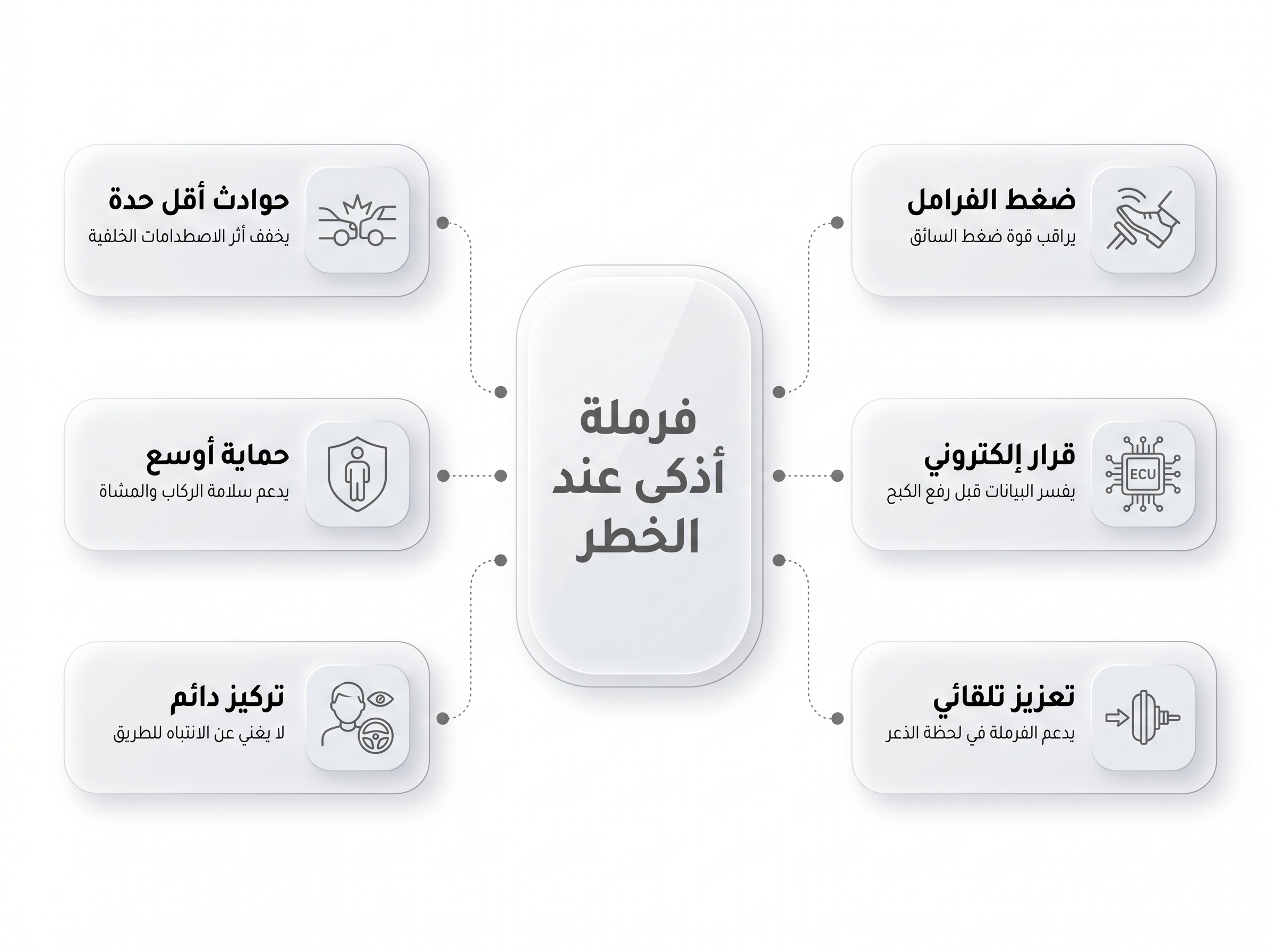
- Brake pressure sensors, which monitor the speed and force of pressure on the pedal.
- The electronic control unit, which is the system's brain, analyzes sensor data to determine if intervention is required.
- The brake booster, which is the mechanical/hydraulic component that executes the control unit's command to increase braking force.
"The system monitors your pressure pattern on the brake pedal, and when the control unit senses rapid pressure indicating panic, it automatically activates to maximize braking force."
The Difference Between Emergency Brake Assist and Automatic Emergency Braking Systems
Despite their close relationship within the safety system, there are important technical differences, as follows:
Brake Assist System: It is a reactive system that requires initial driver intervention. Its function is to enhance braking force after the driver begins to press the brakes, compensating for insufficient pressure.
Automatic Emergency Braking System: This is an advanced safety system designed to prevent accidents by warning the driver of a potential imminent collision. It also automatically intervenes to activate emergency brakes, thereby significantly reducing road risks.
The intelligent braking system operates using two integrated sensing systems: a radar sensor mounted at the front of the vehicle, and a camera mounted in the windshield.
The system collects data from these two sensors to continuously monitor the traffic area in front of the vehicle. It calculates distances and determines the positions and speeds of vehicles ahead, enabling rapid and accurate detection of dangerous situations.
How the Automatic Emergency Braking System Intervenes
The Emergency Braking Assist system intervenes in stages to ensure maximum safety, as follows:
- Warning Stage
When an imminent collision risk is detected, the system issues an initial "visual" warning to the driver via the instrument cluster display and an "audible" warning, alerting them to take appropriate action.
- Automatic Intervention Stage
If the driver does not respond to the warning, the system automatically intervenes and activates emergency braking to avoid or mitigate the collision.
During emergency braking, the system also alerts vehicles approaching from behind through two functions: activating the emergency stop signal in addition to the brake lights, and activating the hazard warning lights which flash rapidly to attract attention, thereby reducing the risk of a rear-end collision.
Another feature of the system is that it is always active and cannot be routinely deactivated, ensuring continuous protection.
"The assist system enhances your braking power, while the automatic braking system intervenes on its own if you don't respond, preventing the accident from happening in the first place."
How does the braking assist system adapt to changing road and weather conditions?
This system does not operate in isolation from its surroundings; instead, it intelligently adapts its response to various road conditions, such as wet or snowy roads, where braking effectiveness is naturally reduced. The system cooperates with traction and stability control systems to adjust the applied braking force and prevent skidding.
Furthermore, some advanced systems take weather conditions into account using data from external sensors, adjusting the sensitivity of warnings and interventions to suit varying levels of road friction.
Impact of the Braking Assist System on Driver Behavior
The presence of this system affects the driver's psychology and behavior, providing a sense of safety and confidence, especially for inexperienced drivers or those navigating challenging traffic conditions. On the other hand, there is a potential risk of overconfidence or over-reliance on the system, which could lead to less cautious driving.
Therefore, car manufacturers emphasize that these systems are aids and not a substitute for human attention and responsibility, and the driver must remain constantly alert.
"The system might give you a false sense of security that could lead to reckless driving; remember it's just an "assist," and human attention remains your primary responsibility."
Why Do We Need Emergency Braking Assist?
The importance of using the automatic emergency braking system is as follows:
- Enhancing Safety and Avoiding Accidents
This is because it reduces rear-end collisions, which result from delayed driver reaction or distraction. The system reacts faster than a human to brake at the critical moment, either to completely avoid the accident or to significantly reduce the impact speed and mitigate its severity.
- Driver support in critical situations
Even skilled drivers may encounter sudden emergencies, such as a vehicle stopping abruptly in front or pedestrians appearing unexpectedly. The system detects these threats and responds in fractions of a second, giving the driver a better chance to react or taking over if it's too late.
Similarly, in panic situations where a driver might not apply the brakes with sufficient force, the system ensures maximum braking power is activated to achieve the shortest possible stopping distance.
- Protecting others on the road
This system naturally has a significant impact on protecting both occupants of other vehicles and pedestrians. This is due to its advanced warning functions, such as activating rapid flashing lights, which immediately alert traffic behind you in case of danger, giving other drivers additional time to react.
Integration of the Emergency Brake Assist System with Other Safety Systems
The brake assist system doesn't work in isolation; instead, it's part of an integrated safety network in modern vehicles, including:
- Braking systems, working in full coordination with Anti-lock Braking System (ABS) to maintain steering control during hard braking, and with the Electronic Stability Control (ESC) system.
- Advanced Driver-Assistance Systems (ADAS) in equipped vehicles, where the system receives data from radar sensors and the front camera, enabling it to understand the surrounding context and anticipate emergencies early.
When might Emergency Brake Assist fail to protect you?
There are some situations that negatively affect the function of the Emergency Brake Assist system, including:
- Impact of severe weather conditions
such as snow, rain, fog, etc., which obstruct camera vision and interfere with radar signals, thereby reducing the system's accuracy in detecting obstacles.
- Contamination or damage to sensors
Any physical obstruction on the sensors limits their ability to detect correctly and may disable the system entirely.
- Electromagnetic interference
For example, in covered parking lots or near strong radar sources, wireless signals can interfere with the radar sensor, leading to incorrect readings.
- Low tire pressure warning
When this warning is active, the system may automatically disable until the issue is resolved, as improper tire pressure affects braking performance.
- Initialization Period After Startup
The system requires several seconds after startup to self-check and calibrate its sensors, and may not operate at full capacity during this period.
- Complex Traffic and Unclear Objects
The system may struggle to identify an object posing a direct threat, especially in heavy traffic or at multi-lane intersections.
- Fast-Moving Objects In and Out of Sensor Range
If an object (pedestrian or bicycle) suddenly enters the detection range at high speed, the system may not have sufficient time to react.
- Hidden Objects
Sensors cannot detect objects hidden behind a car or a pillar, which may result in missing an unseen threat.
- Atypically Shaped or Covered Pedestrians
If a person's shape does not match the stored pattern, for example, someone carrying a large box, the system may fail to recognize them as a pedestrian.
- Sharp Turns
The accuracy of front sensors decreases in tight turns, where the forward detection range is limited or distorted.
"Poor visibility in rain or fog, along with hidden or fast-moving objects, limits sensor capabilities and makes the system fallible."
The Importance of Regular Maintenance and Precise Calibration for Emergency Brake Assist Systems
By regular maintenance, we don't mean routine upkeep, but rather maintenance that ensures this system continues to operate exactly as it was designed.
Modern integrated systems rely on extremely precise sensors. Even a slight misalignment of these sensors, by just a few degrees or millimeters, can cause the system to fail in detecting hazards or even activate the brakes randomly and unnecessarily.
Consequently, calibration becomes a necessary procedure after many common maintenance and repair operations that may affect the vehicle's geometry or sensor placement.
Calibrating these systems is a specialized and complex technical process. Its precise specifications vary from one manufacturer to another, and even between different models of the same vehicle. This process uses advanced equipment, including specialized diagnostic software that connects to the vehicle's computer and guides the technician through the manufacturer-specified steps.
The benefits of precise calibration include ensuring the system activates at the right time and with full force to avoid or mitigate collisions, preventing sudden, unwarranted braking which can be dangerous in itself, as well as preserving the vehicle's value and ensuring its compliance with safety specifications.
Constraints and Challenges to Understand About Emergency Braking Assist Systems
While emergency braking assist technology offers significant benefits, it also presents several important technical and behavioral challenges that every driver should be aware of. These are explained below:
The system's effectiveness critically depends on its sensors' ability to "see" clearly. Harsh weather conditions such as dense fog, heavy rain, snow, or even direct sun glare can obscure these sensors, limiting their detection range and accuracy. This can lead to the system failing to activate in time or, conversely, activating without a real threat (known as "false braking").
Furthermore, some systems, particularly less advanced ones, may struggle to detect pedestrians or cyclists in specific lighting conditions or when they are at the far edges of the vehicle's path. The system's effectiveness also significantly diminishes at very high speeds, where the available distance may not be sufficient to avoid a collision, even with maximum braking force applied. In such cases, its role is often limited to mitigating the impact's severity.
Finally, some drivers may develop a false sense of security, leading them to neglect focusing on the road or to delay their human reactions, believing the system will always take over. This contradicts the fundamental philosophy of these technologies, which are designed as driver "aids," not replacements.


