

When Technology Becomes the Language of Tires
Many people ask a common question when they first hear the name Darbk tires: What makes a Saudi tire so remarkably different from a European or Japanese tire, which have been manufactured for decades? The answer isn't simply "good intentions" or national pride, but something far more rigorous and measurable: technology.
The tire, in its final form—a black rubber component rolling on the road—is, in reality, the product of intricate and complex sciences: material chemistry, structural engineering, heat physics, and digital systems for testing and verification. When Darbk decided to enter this equation with a Saudi identity, it didn't start from scratch. Instead, it began from a more crucial point: understanding the specific needs of the Saudi environment, and then developing the necessary technology to produce solutions that meet those needs.
From the initial material selection and rubber compounding, through the design of internal structures and testing technologies, all the way to the roadmap for a complete Saudi factory by 2030.
The Tire from a Scientific Perspective: How Truck and Car Tires Are Made
Before delving into Darbk's technologies, it's crucial to understand what "tire manufacturing" entails from a scientific standpoint. A tire is far from a simple piece of rubber; it's a complex product that integrates material science, engineering, and physics. It represents the pinnacle of human scientific endeavor, harmonizing natural and synthetic materials with mechanical physics. All of this is made possible through engineering sciences, which provide the tools to bring these concepts to fruition.
Five key elements intertwine to form the tire in its final shape: natural and synthetic rubber, carbon compounds that provide rubber with its durability and rigidity, metal wires that form the internal backbone, synthetic fibers added as supporting layers, and the tread that dictates how the tire interacts with the road. Understanding each of these components is the first step to grasping exactly what Darbk accomplishes in its factories.
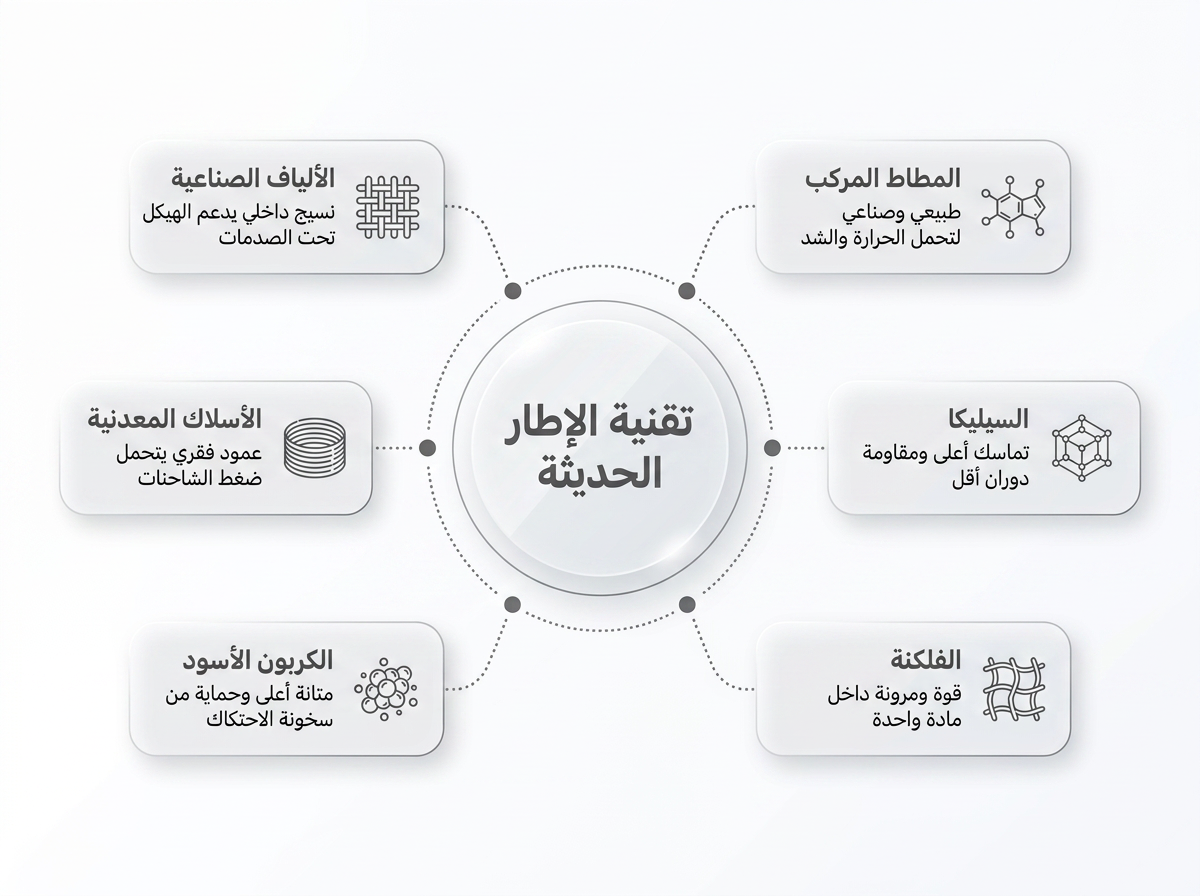
Rubber — The Core Material and the Science of Its Adaptation
Natural Rubber and Its Challenges in the Saudi Environment
Rubber is the most prevalent and influential component in a tire's structure, significantly impacting its road performance. Natural rubber is extracted from trees scientifically known as Hevea Brasiliensis. It boasts exceptional elasticity, a quality not found in many other materials, allowing it to stretch and expand without cracking, even under high pressure. This inherent property makes it the fundamental material in global tire manufacturing.
However, natural rubber alone is insufficient for the extremely hot Saudi environment. The scorching sun, which heats asphalt to over seventy degrees Celsius during summer months, subjects rubber to immense thermal stresses that push its molecular limits. This is precisely where the advanced technologies adopted by Darbk Tire Company come into play: developing enhanced rubber compounds that retain the flexibility and absorption benefits of natural rubber, while incorporating elements that significantly boost its thermal resistance.
Synthetic Rubber: A Necessity Transformed into Science
Let us recount the historical emergence of synthetic rubber: In 1909, German chemist Fritz Hofmann secured the first patent for synthetic rubber, known as "Buna," a blend of butadiene and sodium. World War II then dramatically accelerated the industry's development when the United States, cut off from natural rubber sources, was compelled to launch an emergency program for synthetic rubber. This program led to the birth of Styrene-Butadiene Rubber (SBR), which remains the foundation of synthetic rubber manufacturing to this day.
Today, we precisely combine both types of rubber in formulations that account for each product's nature and intended use: natural rubber for its high elasticity, and synthetic rubber with chemical properties that allow us to fine-tune hardness and thermal resistance according to the specific demands of each individual tire.
Silica and Vulcanization Technology: The Forefront of Modern Tire Manufacturing
One of the most significant technological advancements Darbk relies on for its rubber compounds is the incorporation of silica into the rubber mixture. This technology enhances tire grip on wet surfaces and reduces rolling resistance—two critical factors that profoundly impact both safety and fuel economy.
Alongside silica, the tire manufacturing process utilizes vulcanization—the process of "adding sulfur to rubber and then heating it." This imparts both high strength and extreme flexibility to the rubber simultaneously. This process is particularly effective with polyisoprene rubber and styrene-butadiene rubber, which are among the most efficient synthetic rubbers for resisting high heat.
This technological advancement in rubber compounds isn't an engineering luxury; it's a direct response to the demands of Saudi roads, where tires face temperatures far exceeding what most traditional tires were designed to withstand.
Carbon Black — The Material That Transformed Tires
From White Tires to the Black Era
One of the most amusing details is that tires in the early 20th century were white! They didn't contain carbon black yet, which made them wear out quickly and unable to withstand continuous use. In 1910, scientists discovered that adding this material to rubber "gives it high tensile and compressive strength, making it more durable." This led to the color changing to black and the industry evolving to a new level of modernity and auxiliary materials to improve tire performance.
The Role of Carbon Black in Tire Manufacturing
Carbon black in Darbk tires plays three integrated roles: first, improving durability, as carbon compounds add stiffness to rubber, reducing the likelihood of tearing and wear; second, shock resistance, as carbon black lessens the impact of strong shocks on rubber, which is why it's widely used in off-road tires; and third, improving thermal conductivity, as carbon naturally acts as a heat-dissipating material, which enhances the tire's ability to dissipate heat generated by friction—a particularly crucial factor in the Saudi context.
Recovered Carbon: The Environmental Dimension of Modern Techniques and Technology
Darbk monitors the latest developments in this field, most notably recovered carbon black (rCB), which is produced by recycling used tires through pyrolysis techniques. The blog notes that this type "contributes to reducing carbon dioxide emissions by up to 2% compared to traditional carbon black production, making it a more compatible choice with Darbk's commitment to environmental sustainability trends."
Metal Wires — The Tire's Rigid Backbone
The Unseen Structure of Tires
If rubber is the outer skin of the tire, then metal wires are its skeleton. These wires increase the tire's ability to withstand pressure from the tractor, trailer, or even the truck. They then share the role with the tread to distribute the total pressure across the tire's surface. In other words: metal wires prevent the tire from collapsing under the weight of massive loads.
The wires in heavy-duty truck tires — the sector Darbk primarily started with — are not just straight wires randomly fixed. Instead, they are complex, interwoven networks, some biased and others radial in direction. This variety in their winding and interweaving allows them to accommodate the diverse uses of different tires.
Three Types of Wires for Three Different Uses
There are three types of rigid wires in tire structures:
Traditional Steel Wires: Composed of solid steel alloys, these are used in most tires for trucks and cars, providing high strength and wear resistance.
Heat-Treated Steel Wires: Reinforced steel alloys are heated to high temperatures to increase their flexibility and load-bearing capacity. This type is primarily used in tires requiring high performance in harsh conditions.
Coated Metal Wires: These are steel wires with an added coating of another metallic material like copper or zinc. They possess higher resistance to corrosion and damage, providing sufficient protection for the steel wires and giving the tire a longer lifespan compared to regular tires.
Darbk's selection of the appropriate wire type for each product — be it heavy trucks, construction equipment, or public transport buses — is itself an engineering decision based on precise calculations of load distribution and mechanical resistance.
"Darbk Company Chooses the Best for Saudi Roads"
Synthetic Fibers in Tires: The Hidden Support Layers
Inner Tire Fabric
Synthetic fibers are another unseen component that significantly influences what the driver feels. They are defined as: fibers made from chemically treated materials, giving them distinct physical and chemical properties. These fibers are added to tires as supporting layers, providing good reinforcement for the tire's inner layers, known as Tire Cord Fabric, which enables the tire to maintain its internal structure and withstand strong impacts without disintegration or damage.
From Nylon to Kevlar
We trace the evolution of these fibers over time: In the 1950s, nylon was introduced, laying revolutionary foundations in the tire manufacturing world. Then, in the 1970s, aramid fibers (Kevlar) emerged as an ideal blend of durability, flexibility, and lightweight properties, becoming the most common choice for high-performance tire manufacturing. Today, Darbk keeps pace with the latest developments in this field, including continuous fiber composites, which offer an exceptional strength-to-weight ratio and enhanced durability compared to traditional composite fibers.
The Tread — Where Engineering Meets the Road
The layer that connects with the ground
The tread is the only part of the tire that actually touches the road at every moment of driving. It is known as the outer, upper layer of the tire, typically made from a composite rubber blend that provides durability and rigidity, enhanced with additives to improve its resistance to wear, cracking, and damage. The grooves and channels in the tread are a carefully engineered design that determines how the tire interacts with the road surface.
Four Key Roles of Darbk's Tread Pattern
There are four pivotal roles that the tread plays in every Darbk tire:
Road Grip: The tread is the primary interface between the road and the trucks, making it responsible for maintaining the truck's stability while driving. This requires harmony between the road environment and the design of the tread's grooves.
Total Pressure Distribution: The tread design helps distribute the pressure from the truck's total load across the ground contact surface. This ensures optimal tire performance under heavy pressure, preventing sudden blowouts during highway journeys.
Wear Resistance: As the part that experiences the most friction with the ground, the tread determines how quickly a tire wears out. Darbk therefore focuses on enhancing the strength and durability of the tread layer to ensure a longer lifespan and greater efficiency.
Reducing the Risk of Skidding: The grooves in the tread enhance its ability to drain water and other substances, preventing the truck from skidding due to insufficient ground contact.
Road-Specific Tread Design
We don't view the tread as a single component, but rather as a customizable system based on its intended use. As Darbk's analysis in previous articles illustrates the difference between highway and off-road tires, the distinction between these two tire types begins with the tread design itself:
For highway tires, the tread features parallel lines designed to drain water, reduce friction with asphalt, and minimize noise and vibration. This precise engineering allows the tire to achieve high stability at elevated speeds, shorter braking distances on asphalt, and a smoother, quieter driving experience.
Conversely, for off-road tires, the tread features large, widely spaced rubber blocks with wide gaps to prevent mud accumulation. They also have thicker sidewalls that protect the tire from tearing or cutting when encountering rocks or sharp edges. The company confirms that its internal tests have shown up to a 15% improvement in performance and stability when the appropriate tire is chosen for each road type.
Three Pillars of Tire Quality — Darbk's Technical Cornerstones
We don't just talk about raw materials; we identify three technical cornerstones that form the backbone of quality in every tire we produce:
The First Cornerstone: Tire Reinforcement
This is an engineering process aimed at ensuring better performance and higher safety, while increasing durability and stability, and improving tire lifespan and efficiency on roads. Darbk achieves this reinforcement through three levels: increasing load capacity and durability to withstand heavy loads and rough roads; improving performance and safety by reducing the risks of blowouts or rapid wear; and providing suitable specifications for challenging conditions, such as trucks, buses, and vehicles used on desert and difficult roads.
The Second Cornerstone: Consistent Balance
It's not enough for a tire to be durable; it must also be balanced. Darbk's official website describes this pillar as maintaining tire stability and reducing vibrations, which makes driving smoother and safer, and improves tire performance and lifespan. Its tangible results are evident in three areas: smooth and comfortable driving that reduces vibrations and jolts; economical and long-lasting performance requiring less frequent replacement, thus reducing long-term costs; and improved fuel efficiency that reduces tire resistance and increases fuel economy.
The Third Pillar: Compounding and Curing
This is the stage that determines the quality of the rubber itself as a raw material before it is formed into a tire. This process ensures the production of high-quality rubber with an even distribution of components to enhance the tire's strength and flexibility, and improve its performance in all conditions.
Its three results are: improved rubber quality from optimal component distribution, producing stronger and more flexible rubber; longer durability, reducing internal defects and maintaining the tire's structure for a longer period; and consistent performance, preserving the tire's characteristics in varying temperatures and challenging road conditions.
Testing System — Fifty Non-Negotiable Standards
Pre-Launch Testing System
Darbk does not launch any product to the market until it has passed at least fifty international quality standards. This figure, announced on the company's official website, is not merely a marketing claim but a declaration of its operational methodology. Passing fifty standards means that every tire undergoes a testing system that evaluates each of its properties under simulated conditions for various operating environments.
These tests include precise measurements for thermal endurance at extreme temperatures, wear resistance standards on various surface types, braking and stability tests at different speeds, and evaluations for burst resistance under extreme pressure. Passing this comprehensive system paved the way for Darbk to obtain the Saudi Quality Mark from the Saudi Standards, Metrology and Quality Organization.
Artificial Intelligence in Testing
Among the most prominent recent technological developments in the industry is the use of AI simulation technologies. Tire manufacturers are working to provide AI simulation techniques that enhance tire design experiments, allowing for the creation and virtual testing of models before their physical production. This approach contributes to boosting efficiency in the tire manufacturing market, reducing wasted rubber, and lowering overall testing costs.
The use of artificial intelligence in virtual tire testing represents a fundamental shift in development methodology. Instead of relying entirely on costly and time-consuming physical prototypes, hundreds of scenarios can now be simulated virtually, and the best ones selected before moving to physical prototyping. This accelerates the development cycle and enhances the accuracy of results.
Smart Tires and Sensors
Cyber Tire technology involves enhancing the tread layer with sensors capable of communicating with vehicle systems like ABS and stability control. This helps in understanding the general condition of the tire and when it is considered worn out and unusable. This technology is not merely a futuristic invention but a trend monitored by Darbk's engineering team as part of the industry's technical roadmap.
Global Supply Chain — Over Twenty-Five Partners
Integration, Not Isolation
One of the most prominent strategic decisions Darbk made in building its technical business model was not to attempt to manufacture everything itself. Instead, it built partnerships with over twenty-five certified manufacturers and suppliers worldwide. This approach means Darbk excels in the role of developer, designer, and arbiter, while entrusting the physical manufacturing process to partners who possess deep expertise and advanced infrastructure.
This model is not a concession to the absence of a proprietary factory; rather, it is one of the most mature engineering strategies in knowledge-based industries. True value does not always lie in owning the machinery, but in possessing the formula: precise specifications, strict quality standards, and the testing and verification expertise that ensures the product meets the required level, regardless of its manufacturing location.
International Engineering Team
Darbk employs an engineering team comprising over seven international experts in developing and designing the latest tire technologies. These experts serve as the bridge connecting global technical knowledge with the specific local requirements of the Saudi market. Their role extends beyond overseeing manufacturing to include developing engineering specifications for each model, analyzing field test results, and translating the needs of the Saudi customer into applicable physical and chemical equations.
Technology by Application — The Right Tire for the Right Road
The Micro-Customization Principle
What sets Darbk's technical approach apart from many competitors is its rejection of the 'one-size-fits-all tire' concept. Instead, it applies the principle of micro-customization: each operating environment demands a specific tire with its own unique specifications.
Darbk clearly affirms this direction: the future of truck tires in the Kingdom is moving towards precise specialization. The concept of a single tire effectively fitting all needs will no longer exist. The company's team translates this into practical reality: tires designed for high-speed transport trucks on long-distance roads differ chemically and structurally from tires for quarries and rough terrain, and both differ from tires for urban operations in cities.
Smart Weight Distribution Technology
Among the technologies Darbk highlights in its tire descriptions is smart weight distribution technology in the tread. This technology distributes pressure to minimize irregular wear, thereby increasing tire efficiency and enhancing stability during frequent stops and starts. The company particularly emphasizes this feature in its 'Da'sat Thabat' (Stability Tread) tire, designed for long urban journeys.
The Saudi Factory 2030 — A Vision Seeking Ground
From International Partnership to Local Manufacturing
Darbk's planned factory by 2030 represents the biggest transformation in the company's technical journey: a shift from a development and marketing model to a full manufacturing model on Saudi soil.
Once Darbk establishes a factory on Saudi soil, many dynamics will change. The development cycle will accelerate, eliminating geographical intermediaries between the engineering team's decision to modify a specification and the actual production of the new model. Customization capabilities will deepen, as a local factory allows for more precise adjustment of production processes to meet local market demands. Furthermore, the supply chain will become more stable, with prices and availability no longer subject to international shipping fluctuations and global pressure points.
Developing National Talent
The aspect Darbk clearly emphasizes in its factory plan is that it's not merely an economic project, but a national talent development initiative. The factory will create new job opportunities for Saudi professionals and provide a practical training environment for Saudi engineers to learn tire manufacturing technologies hands-on, directly within the factory, rather than through screens.
This localization dimension not only complements the Kingdom's Vision 2030 for localizing strategic industries but also solidifies technical knowledge within Saudi society. This represents a step with a broader scope and deeper impact than merely creating job opportunities.
Conclusion: Technology is Not an End, But a Means
When you combine all these elements — rubber mixing and vulcanization, both traditional and recycled carbon black, three types of metal wires, synthetic fibers from nylon to Kevlar, tread design tailored to road conditions, a testing system with fifty standards, and a team of international experts and global partnerships — the picture becomes clear: Darbk is not merely a company that sells tires; it's a company that produces customized engineering solutions for specific roads and environments.
At Darbk, technology doesn't exist for its own sake; it serves a specific purpose: to ensure Saudi drivers reach their destinations safely, and for logistics fleet managers to find in a Darbk tire a reliable partner that won't let them down, whether in the desert or amidst the challenging curves of the south.
Most importantly, this technology is still under development, not yet complete. With the upcoming factory by 2030 and the company's continuous monitoring of every advancement in rubber science, carbon, fibers, and artificial intelligence, Darbk's most exciting technical chapters have yet to be written.


