

Introduction: When Tires Become a Saudi Story!
In Riyadh, where highways stretch like threads connecting the region between the Arabian Gulf and the Red Sea, and where summer asphalt temperatures reach limits unbearable for most known rubber materials, an idea began to form in the minds of a group of young Saudis. It was an idea that seemed simple on the surface, but at its core carried the weight of a question that had long puzzled transportation experts in the Kingdom: Why doesn't Saudi Arabia have its own national, local tire brand, for both cars and trucks?
"Darbk's story... is a success story that cannot be easily overlooked!"
The question was not a matter of intellectual luxury; rather, it reflected a genuine need felt by every truck fleet manager and every driver who covers hundreds of kilometers daily between cities and strategic logistical sites. Imported tires dominated the Saudi market, and Saudi users paid for a product whose manufacturer didn't necessarily understand the challenges of the road between Riyadh and Tabuk, or between Jeddah and Asir, or deep in the Empty Quarter where heat is a factor that cannot be compromised.
From this reality, Darbk was born, not as a commercial company seeking an opportunity in a mature market, but as a vision aiming to prove that national and local products can compete, and even excel, in a sector considered one of the most sensitive globally regarding quality and safety.
This article tells Darbk's story: How did it start? What were its foundations? And how is it progressing on a journey to change the rules of the game in the Saudi and Gulf tire market?
Chapter One: The Genesis of the Idea in an Era of Imitation
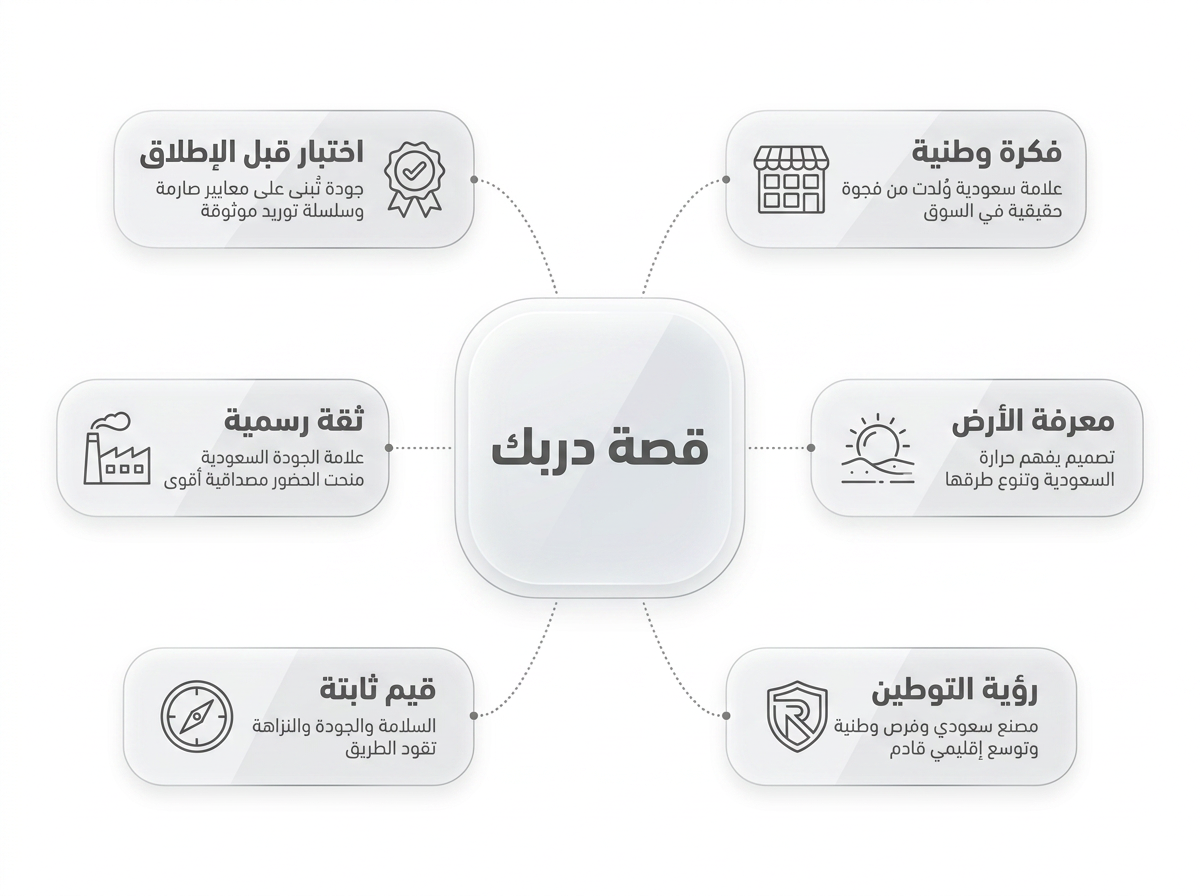
The Saudi Market Before Darbk
To understand what Darbk created, we must first understand the reality in which it was born. The tire market in Saudi Arabia was a space dominated by importers of major European, Japanese, Korean, and Chinese brands. While these brands offered products of varying quality, they all shared one thing: they were not originally designed for the Saudi road with its unique challenges, fluctuating weather, and the difficulty of adapting to both extremely low and extremely high temperatures.
Saudi Arabia is not an ordinary market; it is a subcontinent with unparalleled topographical diversity: scorching hot deserts in the east and center, rugged mountains in the southwest, and coastal roads with humidity and salty air from the sea. Heat alone is enough to be fatal for traditional tires, as asphalt surface temperatures in some areas exceed 70 degrees Celsius during summer months, placing tires under constant, relentless stress.
Furthermore, Saudi Vision 2030 began to outline a massive economic transformation across all industrial and non-industrial sectors in Saudi Arabia. As a previous Darbk blog report revealed, the Kingdom aims to become a global logistics hub connecting three continents, which means a huge increase in truck and commercial vehicle traffic, and consequently, a rising demand for tires capable of meeting these new pressures.
The Idea Becomes a Viable Project in the Tire Sector
In this context, Darbk was founded to answer a question posed by reality: If the Kingdom is capable of building national industries in complex sectors like petrochemicals, defense, and mining, why doesn't it have a national tire brand, which is an integral part of all other sectors and industries?
The answer didn't come in the form of a speech or a statement, but in the form of a product. A product bearing a name that encapsulates its entire vision in one word: Darbk. Darb, which means "path" or "road." This name is not just a brand; it's a clear message that says: We don't make a generic tire for all markets; we make a tire specifically for your road, Saudi driver, for your environment and your unique challenges.
As the company's slogan clarified, the name carries three intertwined meanings: "Darb" meaning the physical road the driver travels, the journey with all its connotations of effort, challenge, and arrival, and trust and conscious choice.
Chapter Two: Building on Foundations of High Quality
Pre-Launch Testing
Perhaps what most distinguishes Darbk from many startups is that it didn't rush its market launch. Instead, its team, comprising over seven international experts in tire development and design, focused on developing products that pass more than fifty stringent international tire standards. This number isn't for show; passing fifty standards means that every Darbk tire has undergone a series of tests including thermal resistance, stability under heavy loads, skid resistance, tread depth and wear rate, cut resistance on rough roads, and fuel efficiency.
"The tire in your hands has passed dozens of tests before it's ready for installation and to hit the road."
The engineering team was not working in a vacuum; it relied on a global supply chain comprising over twenty-five certified manufacturers and suppliers. This reveals that Darbk does not operate on a "do it yourself" principle, but rather on "choose the best globally and adapt it for the local market." This philosophy makes Darbk a company of development and local market knowledge as much as it is a manufacturing company, a rare combination in emerging markets.
Saudi Quality: An Achievement for the History Books
In February 2025, Okaz newspaper published news it described as "a step reflecting national leadership in the tire manufacturing sector": Darbk tires received the Saudi Quality Mark issued by the Saudi Standards, Metrology and Quality Organization (SASO), becoming the first Saudi brand to achieve this milestone in the tire market.
This sentence deserves to be read again: the first Saudi brand, not the first Gulf brand, nor the first in the region, but specifically the first Saudi brand in this sector to obtain this official certification.
The Saudi Quality Mark is not a certificate easily granted. As Okaz clarified in its report, it is only awarded to products that pass rigorous tests ensuring the highest levels of quality and safety. Darbk's success in passing these evaluations, according to the newspaper, made it "a trusted choice for consumers in the Saudi and Gulf markets, and confirms the national product's position as a strong alternative to imported tires."
Emphasizing that Darbk is "the first company to obtain the Saudi Quality Mark" in the tire sector, which we describe not merely as a certificate we highlight, but rather "a commitment we began from day one and are pursuing towards leadership."
Chapter Three: Products that Embody the Philosophy
The Tire Family: From Truck to Aircraft
What surprises the reader is that Darbk did not limit itself to specializing in one type of tire, but rather built a comprehensive product family covering four main sectors:
Truck and Bus Radial (TBR) Tires: This is the core of the company's work and its primary pillar. In this sector, Darbk offers a range of tires designed for heavy-duty transport on long highways, within cities, and for regional shipping routes. This family includes models with Arabic names reflecting their identity, such as Tuwaiq tread (DBK 103), Rawasi tread (DBK 102), and Marin tread (DBK 101).
Off-the-Road (OTR) Tires: This sector demands highly precise specialization, as tires operating in quarries, mining sites, and major infrastructure projects face harsh conditions unlike any others: sharp rocks, extremely heavy loads, and uneven surfaces. Darbk has developed tires for this sector with special cut-resistant rubber compounds.
Passenger Car Radial (PCR) Tires: These include sedans, SUVs, and family cars. Here, the challenge shifts from the world of industrial durability to the world of comfort, fuel efficiency, and quietness on the road.
Aircraft (AIR) Tires: This is the most attention-grabbing sector, as aircraft tires operate under exceptional performance conditions involving extreme speeds and loads during takeoff and landing. Darbk's entry into this sector signals an ambition that transcends the traditional positioning of startups.
Treads with Names that Tell an Ancient Saudi Story
What is remarkable about Darbk's products is that their Arabic names were not chosen randomly. "Tuwaiq" refers to the famous Tuwaiq mountain range that stretches across the center of the Kingdom. "Rawasi" means "the firmly established," indicating stability and rootedness. "Marin" suggests flexibility and adaptability. "Masar" means "path" or "route." These designations are not minor details; they are part of the company's philosophy, which views the tire as part of the Saudi road identity, not just a soulless imported commodity.
Chapter Four: Knowing the Terrain... The Real Advantage
Diverse Topography: The Defining Challenge
The Kingdom of Saudi Arabia is "a miniature continent with diverse and harsh topography." This diversity means that a tire suitable for the long, straight roads of the Empty Quarter is not necessarily ideal for the mountainous obstacles in Asir and Al-Baha with their sharp curves, nor for coastal roads that combine humidity and heat.
This analysis reveals that in the Saudi market, a tire is not sold as a standardized product, but rather understood as a customized solution for a specific operational environment. This is precisely what Darbk offers: a precise understanding of the local market based on documented expertise and a team that comprehends that the road from Riyadh to Jazan differs fundamentally from the road from Jubail to Jeddah.
Heat: The Greatest Enemy
One of the key highlights Darbk emphasizes in its product specifications is that its tires are "specifically designed to withstand the harshest conditions," a direct reference to the Saudi climate. The company points out that asphalt temperatures in summer months can exceed 70 degrees Celsius, turning the road into a "scorching surface that tests the physical and chemical limits of rubber."
To address this challenge, Darbk focuses on three main pillars: first, using advanced rubber compounds that reduce internal heat generation within the tire during rotation; second, designing internal tire structures that distribute the load evenly to prevent heat concentration in specific areas; and third, testing tires under simulated Saudi environmental conditions before launching them into the market.
Fuel Efficiency: The Economic and Environmental Dimension
With the Kingdom's strategic shift towards sustainability as part of the "Saudi Green Initiative," fuel efficiency has become a crucial factor in tire selection. Darbk's blog indicates that tires with low rolling resistance can reduce diesel consumption by up to fifteen percent, a significant percentage when applied to a truck traveling 150,000 kilometers or more annually.
This dimension adds more to the equation than just the purchase cost: fuel savings, reduced carbon emissions, and compliance with sustainability standards that future environmental legislation is beginning to impose.
Chapter Five: Clients Who Chose Darbk
Names That Reveal Trust
The most telling statement about Darbk isn't what it writes about itself, but what its client list reveals. In an industry where established global brands compete with hundreds of millions of dollars in marketing budgets, Darbk has successfully earned the trust of major names like CMA CGM, one of the world's largest shipping companies, in addition to Sal Transport, Nadec, Aramex, and several other large industrial and service companies in the Kingdom.
This list doesn't mean these companies merely bought a few tires for trial. Companies the size of Aramex and CMA CGM don't change tire suppliers as easily as one changes clothes. A decision to purchase from a new supplier in the tire sector involves a meticulous quality assessment, a long-term total cost analysis, and field trials on their actual fleet. Darbk's success in passing these tests with such prominent names is, in itself, a stronger endorsement than any accreditation document.
Targeted Sectors: A Methodical Approach
Darbk did not launch its products for everyone all at once; instead, it built its strategy around identifying four specific sectors and offering tailored solutions for each:
The logistics transport sector, which includes long-haul freight and distribution trucks, requires tires that combine durability, fuel economy, and absolute reliability in the quality that connects the truck to the road. The public transport sector, encompassing buses and government fleets, prioritizes safety and tire longevity. The industrial transport sector, serving factories and the oil and gas industry, needs ultra-durable tires capable of operating within industrial sites under exceptional conditions. Finally, the ready-mix concrete and contracting sector, which includes mixers, dump trucks, and construction site equipment, is one of the harshest sectors for tires.
This sectoral specialization reflects a mature understanding of the market and the growing needs driven by the increasing number of diverse projects in Saudi Arabia, which attracts thousands of investors from around the world. Instead of offering a "general" tire for everyone, Darbk provides a customized solution for each type of use, a philosophy consistent with what Darbk's own blog predicted for the future of the tire industry: precise specialization, not a "one-size-fits-all" tire.
Chapter Six: A Warranty Beyond the Product
Twelve Months of Written Assurance
Darbk offers an official twelve-month warranty on all its tires. This figure alone isn't enough to evaluate the company, but the surrounding context is important: when a startup issues an official warranty, it declares its complete confidence in its product. And when it obtains the Saudi Quality Mark before launching its warranty, it adds an unquestionable institutional backing to this confidence.
After-Sales Service: The Completing Link
The Darbk team understands that a tire's value isn't measured solely at the moment of purchase, but by what happens afterward. Therefore, the company has given clear attention to after-sales service and building a sustainable relationship with the customer. This is why Darbk defines itself as a "partner on the road," not merely a supplier who delivers tires and then closes the file.
The Concept of Total Cost of Ownership
One of the key concepts Darbk promotes in its marketing discourse is the Total Cost of Ownership (TCO). This represents a shift in purchasing mindset from "What's the cheapest tire I can get right now?" to "Which tire offers me the lowest long-term cost?" and over five years of continuous use.
Darbk illustrates this concept with a direct calculation example: a higher quality, higher-priced tire lasts twice as long as a cheap, budget-friendly tire, which ends up costing more in the long run, especially when maintenance costs, truck downtime for tire changes, and accident risks from premature tire blowouts are added to the equation.
This message doesn't just market a product; it re-educates the buyer on how to think about their purchasing decision.
Chapter Seven: From Brand Vision to National Vision
Darbk and Vision 2030: Not a Coincidence
Darbk explicitly states in its corporate philosophy that it "considers the localization of industry a part of its national responsibilities, working to achieve it by 2030." This framing transforms Darbk from merely a commercial company into a player in the grand national project.
Vision 2030 has not been far from Darbk's incubator. Through its National Transport Strategy, Saudi Arabia aims to become a global logistics platform, which implies a growing need for reliable tires to fuel this growth. The Saudi ambition "does not stop at meeting local needs, but extends to making the Kingdom the premier logistics platform connecting the East, the Middle East, and North Africa."
In this context, Darbk finds itself at the heart of the equation: the more logistics movement grows, the more demand there is for its tires, and the more it proves its quality, the more it enhances the reputation of national products at the regional level.
Factory 2030: The Biggest Step
Darbk announced its intention to establish a Saudi factory for tire production by 2030. This announcement adds a new dimension to Darbk's story: the transition from the development and marketing phase to full-scale manufacturing on Saudi soil.
And as Okaz newspaper pointed out in an article on its official website, this direction "aligns with Saudi Vision 2030, which aims to localize strategic industries and enhance reliance on national products," and contributes to creating new job opportunities for Saudi talents.
The transition from import and development to local manufacturing is not just an economic step, but a qualitative shift in the nature of the institution. When Darbk produces its tires on Saudi soil, it will be able to customize the product more deeply, reduce costs, accelerate the development and innovation cycle, and foster national pride in a product not manufactured elsewhere in the world and then shipped to the Kingdom.
Chapter Eight: The Brand Identity Speaks
A Logo with a Message, Not Just Ornamentation
One dimension Darbk pays significant attention to is its brand identity and logo. As we explained earlier, the logo was not the result of a quick design decision, but rather the product of a clear vision aiming to translate the company's values into a visual language.
The logo embodies three main principles: Clarity, reflected in its direct, uncomplicated design that is easily understood. Stability, suggested by its balanced, strong yet non-aggressive lines. And Continuity, emphasized by the logo's simplicity and its ability to withstand the test of time without appearing old or dated.
Darbk emphasizes a clear philosophy: "A good logo convinces you not with words, but with feeling." Accordingly, Darbk's logo doesn't just introduce the company; it silently addresses the driver: "We thought of you. We thought of your safety. We thought that the tire would be with you in tough conditions."
The Knowledge Blog: Giving Before Taking
Darbk chose to establish its digital presence through a rich and diverse content blog. Instead of merely relying on promotional pages, the company regularly publishes articles that educate drivers and fleet managers on how to think about tires: how to measure tread depth, the difference between highway and off-road tires, how long stops affect tire pressure, and the relationship between tire size and truck speed.
These articles generally do not directly promote Darbk's products; instead, they build reader trust in the company as a reliable reference. This approach, which offers knowledge before asking for a sale, is one of the smartest marketing strategies in the startup world.
Chapter Nine: Internal Quality Standards
Three Pillars of High Quality
In its operations, Darbk identifies three core pillars upon which the quality of its tires is built:
First: Tire Reinforcement, a process that ensures increased durability and resilience to withstand heavy loads and rough roads for longer periods, while also improving safety features and reducing the risk of blowouts or rapid wear during driving.
Second: Regular Balancing, which maintains tire stability and reduces vibrations for a smoother, safer ride, while also improving fuel efficiency and extending the tire's lifespan.
Third: Mixing and Curing, a process of producing high-specification rubber that ensures even distribution of components to enhance strength and flexibility, and maintain the tire's properties across different temperatures.
The Six Values: Your True Partner is One Who Upholds Their Principles!
Darbk doesn't just define itself by what it produces, but by what it believes in. The company has established six values that form its internal culture: Safety, considered "the essence from which everything stems"; Localization, as a national responsibility; Quality, as an identity, not just specifications; Responsibility, from every team member; Integrity, as "an inherent part of the corporate character"; and Excellence, as a fundamental pillar upon which the company is built.
These values are not just slogans on walls; they are the standard by which Darbk evaluates its decisions, from selecting suppliers to handling customer complaints, and setting testing standards before launching any product.
Chapter Ten: Achievement in the Face of the Market
Facing the Giants
It's no secret that the global tire market is dominated by several major brands that own tens of billions in assets, operate factories in dozens of countries, and have a market presence spanning decades. Competing with these brands is not like traditional competition; it sometimes resembles what experts refer to as "David and Goliath," illustrating the difference between apparent strength and true strength.
Nevertheless, Darbk has succeeded in establishing its presence, not because it's cheaper or used inferior materials, but because it offered what major brands cannot: deep knowledge of the local market, quick responsiveness to its needs, and the ability to build a personal relationship with the Saudi customer.
In an industry where trust is measured in kilometers and years, every customer who chooses Darbk and renews their order is a testament that cannot be bought with advertisements.
Regional Impact
Okaz newspaper reported that Darbk's achievement in obtaining the Saudi Quality Mark "opens the door for Darbk's expansion into regional and global markets in the coming years." This expansion is not an individual ambition but a logical outcome for a company that has built its credibility on certified quality.
Gulf countries share many geographical, climatic, and economic challenges with the Kingdom. What works for Saudi roads is largely suitable for Emirati, Kuwaiti, and Omani roads. This gives Darbk a natural starting point for regional expansion without needing to reinvent the product from scratch.
Conclusion: Darbk is still at the beginning, and the best is yet to come!
The Unfinished Story
When you examine Darbk's story closely, you'll realize that what has been achieved so far is just the beginning, not the culmination. The company has proven its ability to establish a market presence, deliver a product that passes the most stringent national quality tests, and earn the trust of major clients across the region.
However, the greater ambition still lies ahead: a Saudi factory producing tires on the very ground they're driven on, regional expansion that brings the Darbk name to drivers in Dubai, Muscat, or Kuwait, and perhaps one day, a Saudi brand competing globally in a sector that has been monopolized by a limited number of major corporations for decades.
What does Darbk teach us?
Darbk's story doesn't just teach us about tires; it teaches us that true innovation doesn't necessarily mean inventing something entirely new. Instead, it can mean taking an existing product and redesigning it from a fresh perspective to address a real, unmet need.
It teaches us that competing with giants is possible when a smaller scale is compensated by profound knowledge and a sincere mission.
And it teaches us that a country's name can be an added value, not just a geographical label, when it's associated with a product worthy of pride.
Darbk is not just a tire rolling on the road; it's proof that the Saudi path can carry, alongside trucks and cars, national industrial dreams that defy import barriers.


