Every driver must be well-versed in ways to avoid traffic accidents, which are a top priority for public safety in the Kingdom of Saudi Arabia, as the wise leadership places great importance on the safety of citizens and residents on the roads.
Despite the significant progress the Kingdom has made in reducing traffic accident fatalities, there is still a long way to go to achieve the goals set out in Saudi Vision 2030.
In this comprehensive article, we review the latest traffic statistics in the Kingdom, analyze the primary causes of accidents, and provide practical, evidence-based tips on how to avoid them, helping you play your part in promoting a culture of road safety and raising awareness among all road users.
The Reality and Evolution of Road Safety in the Kingdom Between 2016 and 2025
The Kingdom of Saudi Arabia has seen a tangible shift in road safety indicators, according to the 2025 Annual Report of the Ministerial Committee for Traffic Safety. National efforts have resulted in a historic decline in accident fatalities of over 60% between 2016 and 2025, with the number of deaths dropping from 8,632 to 4,438, while injuries have decreased by 34%.
Regarding serious accidents, their number fell from 23,263 in 2019 to 17,805 in 2025, a decrease of approximately 23%.
Road safety interventions have contributed to massive economic savings, estimated at approximately 83.6 billion riyals between 2016 and 2025.
Despite this unparalleled progress, traffic accidents remain a challenge that requires continued integrated national efforts, as their direct economic losses reached approximately 2.2 billion riyals over two years.
"Traffic accident fatalities in the Kingdom dropped by over 60% between 2016 and 2025, from 8,632 to 4,438 deaths."
Top Causes of Traffic Accidents in Saudi Arabia
The causes of traffic accidents in Saudi Arabia vary, as revealed by the 2025 report from the Ministerial Committee for Traffic Safety. The leading cause is failing to maintain a safe distance between vehicles, accounting for 29.2% of accidents.
Following closely is sudden swerving, which caused 27.9% of accidents, making these two behaviors alone responsible for more than half of all traffic accidents on the roads.
The remaining causes are distributed in varying proportions; failure to yield the right of way ranks third at 10.3%, followed by distracted driving at 5.6%, while driving against the flow of traffic accounts for 0.7% of total accidents.
Data also shows that the majority of traffic accidents occur due to a vehicle colliding with another moving vehicle, as this type accounts for the largest share by a wide margin, exceeding 92.8% of total accidents.
The other types occur at significantly lower rates compared to the first; collisions with parked vehicles rank second at 3.7%, followed by collisions with fixed objects at 1.6%, while the remaining 0.4% is split equally between rollover accidents and pedestrian accidents.
The General Directorate of Traffic has confirmed that the most common causes of accidents across various regions of the Kingdom are summarized in three main behaviors: sudden swerving, failure to maintain a safe following distance, and using a mobile phone while driving, which reflects the importance of focus and awareness while driving to avoid these risks.
"Failure to maintain a safe distance and sudden swerving together cause more than half of all traffic accidents."
How to Avoid Traffic Accidents: Practical Tips for Safe Driving
Below, we review the most prominent ways to avoid traffic accidents, divided into key areas that cover all aspects:
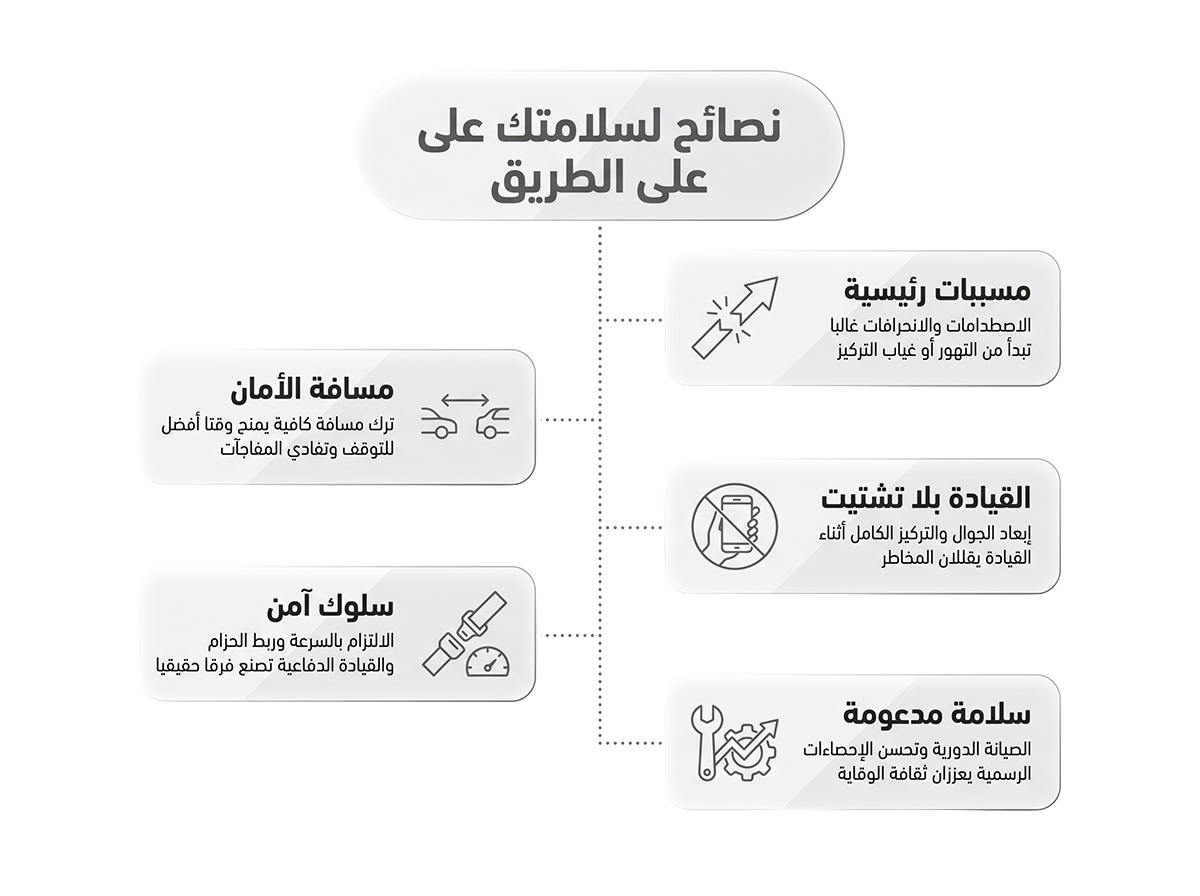
- Maintaining a Safe Following Distance
Maintaining a sufficient safety distance is one of the most important elements of traffic safety, as statistics indicate that failing to leave enough space between vehicles causes 29.2% of traffic accidents.
Therefore, keeping a safe distance between your car and the vehicle in front of you is the easiest way to protect yourself from road surprises, as it gives you enough time to react quickly if an emergency occurs.
To stay safe, ensure that the distance between you and the car in front of you is approximately three to four seconds, especially when Driving at high speedsHowever, if the weather is poor or the road is wet, it is best to double this distance, as the vehicle requires a longer distance to come to a complete stop during sudden braking in these conditions.
- Avoid sudden swerving
Sudden swerving is one of the most dangerous driving behaviors on the road, accounting for approximately 27.9% of all accidents. To avoid this risk, you must plan your route well in advance before reaching intersections and exits, while ensuring you use turn signals to warn others before changing lanes or directions.
It is also recommended to limit lane changes and avoid them unless absolutely necessary. Always check your blind spots thoroughly to ensure no surrounding vehicles are hidden before moving into another lane, ensuring safe passing and turning.
- Distracted driving
Experts confirm that using a mobile phone while driving is the hidden cause behind most sudden swerving accidents and failure to maintain a safe distance. Looking at your phone for just 3 to 5 seconds is equivalent to driving the length of an entire football field without looking at the road.
Therefore, it is best to rely on headsets or hands-free systems only for urgent matters, and to completely refrain from browsing social media or typing messages.
The traffic system also imposes strict penalties for this violation, with fines ranging from 500 to 900 Riyals, in addition to traffic points being recorded against the driver.
"Looking at your phone for 3-5 seconds is equivalent to driving the length of a football field without looking at the road, and the fine ranges from 500 to 900 Riyals, with traffic points recorded against the driver."
- Adhering to speed limits
Excessive speed turns minor accidents into disasters. With the new amendments to the traffic system, speeding violations are now considered offenses that endanger public safety.
It is recommended to adhere to the speeds indicated on road signs, reduce speed in residential areas and near schools, and stay alert for road changes and curves.
- Fasten your seatbelt
Make sure to fasten your seatbelt before starting the engine, ensure it is in good condition and undamaged, and never neglect to use it, even on short trips.
- Periodic Vehicle Maintenance
Periodic vehicle maintenance is one of the most important ways to avoid traffic accidents, as it prevents drivers from experiencing sudden mechanical failures that could lead to a loss of control on the road.
It is recommended to regularly inspect tires and ensure proper air pressure in them, in addition to continuously checking the efficiency of the braking system and ensuring that the front and rear lights are ready for clear visibility.
You should also always ensure that emergency tools andthe spare tire are in good working condition, while making sure to perform comprehensive periodic inspections at authorized service centers on a regular basis.
- Driving in Adverse Weather Conditions
Road risks multiply and visibility levels drop sharply when driving in adverse weather conditions, such as heavy rain and dense fog.
Safe driving in these conditions requires taking special precautions, including using dedicated fog lights and completely avoiding high beams, as they reflect light and make visibility even more difficult. It is also important to reduce speed and limit lane changes or sudden stops, except in cases of extreme emergency.
You should also remain calm and keep both hands on the steering wheel to maintain control of the vehicle if you encounter a sudden scenario, such as a tire blowout while driving. Avoid slamming on the brakes; instead, gradually lift your foot off the accelerator until the car slows down and comes to a safe stop on the side of the road.
- Child Safety in Vehicles
The most prominent regulations include prohibiting children under the age of ten from sitting in the front seat and never leaving them without an adult companion, as well as the necessity of providing dedicated child safety seats and ensuring all passengers wear seat belts.
"Children under 10 years old are prohibited from sitting in the front seat; dedicated safety seats must be provided and seat belts must be worn."
- Defensive Driving
Defensive driving is a proactive approach based on constantly anticipating the mistakes of others and being fully prepared to handle them, making it one of the most effective ways to prevent road accidents.
This practice relies on maintaining full focus and keeping your attention on traffic flow, while consciously monitoring all road users, especially vulnerable groups such as pedestrians and cyclists.
One of the most important rules of defensive driving is not to assume that other drivers will strictly follow traffic laws. Caution at intersections requires coming to a complete stop and checking both ways before proceeding.
The Role of Traffic Awareness in Enhancing Safety
Traffic awareness plays a vital role in promoting a culture of road safety in the Kingdom and encouraging compliance with traffic rules. The General Directorate of Traffic continues to organize awareness campaigns with slogans such as "Don't let notifications distract you," aimed at reducing phone use while driving. The Kingdom also participates annually in Arab Traffic Week events to reinforce the culture of adhering to traffic regulations.
The Saudi Traffic System and Deterrent Penalties
Recent amendments to Article 74 of the Traffic Law have introduced deterrent penalties for violations that endanger public safety. These penalties escalate, reaching the maximum fine for a second repeat of a serious violation within one year, and referral to court, which may impose a prison sentence of up to one year for a third offense, along with the deportation of non-Saudi violators upon a final conviction.
These firm measures target the most dangerous behaviors on the road, primarily driving under the influence of alcohol or drugs, drifting, driving against traffic, running red lights, and overtaking on dangerous curves or hills.
They also include significant speeding, such as exceeding the limit by more than 30 km/h on highways with a 140 km/h limit, or by more than 50 km/h on roads with a limit of less than 130 km/h.
"The graduated penalties include imposing the maximum fine for a second repeat offense, imprisonment for up to one year for a third repeat offense, and deportation of non-Saudis upon final conviction."
Additional Tips for Enhancing Road Safety
Below are some additional tips on how to avoid traffic accidents:
- Get enough rest before driving, as fatigue and drowsiness cause serious accidents.
- Avoid driving under the influence of medications that cause drowsiness.
- Respect pedestrian rights and come to a complete stop at designated crossings.
- Ensure your vehicle registration and driver's license are up to date.
- Contact road security when needed by calling 996.
- Exercise caution during holiday seasons, as accident rates increase by about 15%.
In concluding this article, we reiterate that accident prevention methods should be treated as daily habits that we must instill in ourselves and our children.
Every decision you make behind the wheel—from buckling your seatbelt and maintaining a safe following distance to keeping your phone out of reach—can be the difference between life and death.
The Kingdom of Saudi Arabia has achieved significant milestones in road safety, but the journey toward zero fatalities still requires a collective commitment from all road users.