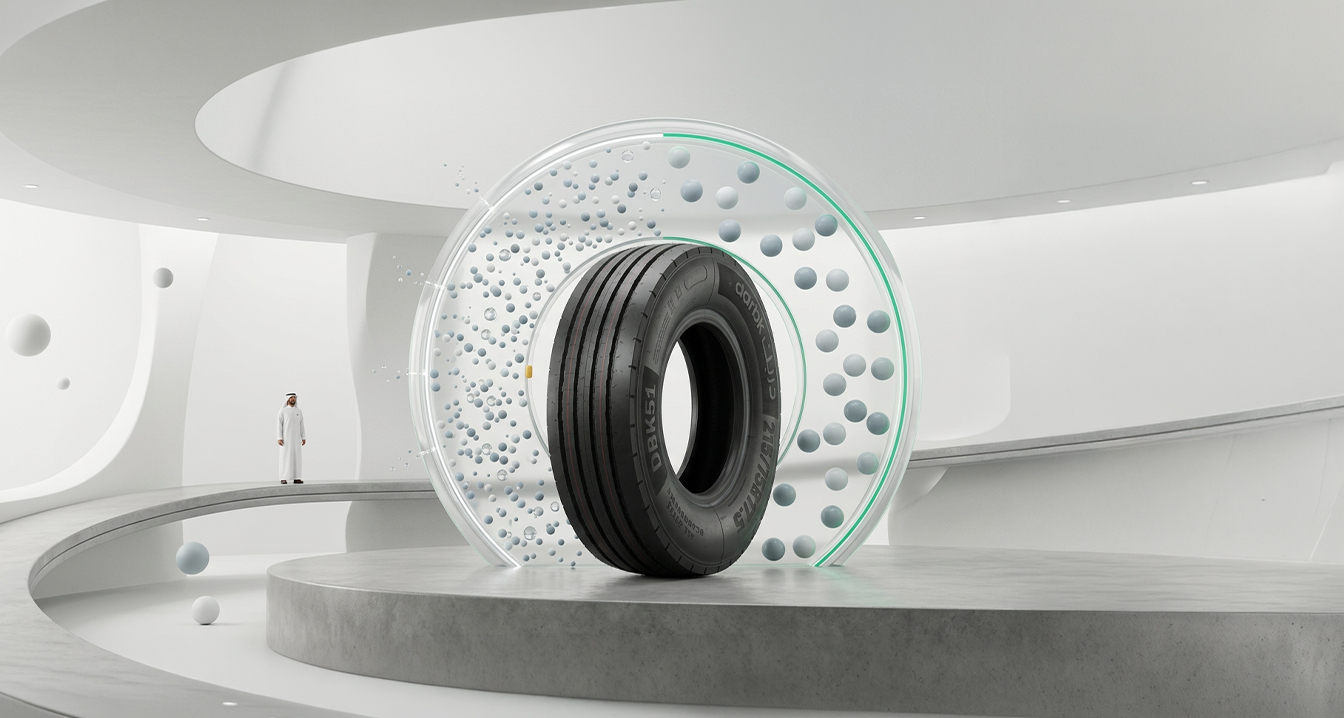
Tires are among the most crucial parts of a truck, as they directly contact the asphalt and handle weight, pressure, and heat—all highly variable factors. This inherently impacts the truck's performance, both positively and negatively. Therefore, truck drivers must be diligent in identifying the best type of tires that suit their needs and truck model to ensure road safety and enhance vehicle performance. Truck tires affect three key characteristics: braking, stability, and fuel consumption. Furthermore, you should be aware of the tires available in Saudi Arabia and the Gulf region that are commonly used in our area, as the surrounding environment significantly influences tire efficiency. You might now be wondering if there are substantial differences that affect these aspects. The answer lies in the following section.
The Difference Between Truck Tire Types
Tire types vary significantly in their ability to withstand specific pressures and temperatures, which result from the wheel's friction with the asphalt. Tire sizes and thicknesses also differ, a variation stemming from the diverse uses and surfaces the wheels encounter. They are generally divided into the following main types:
All-Terrain Tires
This type of tire is suitable for all climatic and environmental conditions and is best suited for flat asphalt roads due to its ideal balance, allowing it to handle poor and rough asphalt surfaces.
Heavy-Duty Tires
If you work in cargo transport or other tasks that require maximizing your truck's capacity, this type is ideal for you. These tires withstand high pressure and daily use, and furthermore, they are capable of handling highways and varying environments.
Off-Road Tires
They are noisy but highly effective at handling rough terrain due to their aggressive tread. Designed for uneven surfaces, they don't offer a good experience on asphalt, but when it comes to mud, rocks, and sand, they are undoubtedly the best.
Mud Tires
As their name suggests, these tires are best for muddy conditions and unpaved roads. They prevent slipping on mud thanks to their wide-grooved tread, which sheds mud and prevents it from sticking to the tread face, thus providing an excellent experience for navigating muddy paths.
Winter Tires
Winter tires feature protrusions on their surface, enabling them to handle icy conditions and increase vehicle stability on snow. These may not be common in Saudi Arabia.
These are the main types, but they encompass various sizes and load capacities. Therefore, you need to know the specific type for your vehicle, which can be found in the truck's catalog. There, you will find the designated tire type for that truck, written in a specific format of numbers and letters, which we will learn about in the next section.
Tire Specification Chart Codes
Tire specification chart codes provide important information such as tire width, aspect ratio, construction type, rim diameter, load index, and speed rating. For example, the code 295/80R22.5 means the tire width is 295 mm, the aspect ratio is 80 percent, the letter R indicates a radial tire, and 22.5 is the rim diameter in inches. The load index represents the maximum weight the tire can carry, and the speed rating indicates the maximum safe speed the tire can withstand.
How to Determine the Right Tire Size for Your Truck
We will explain using a real-world example: 215/75R17.5
- First: The number "215" on the left indicates the tire's width, meaning the tire is 215 mm wide.
- Secondly: The next number, "75," represents the aspect ratio, which is the ratio of the tire's sidewall height to its width, expressed as a percentage. This means the sidewall height is 75% of its 215 mm width, equating to 161 mm.
- Thirdly: The letter "R" indicates the tire type, signifying it is a radial tire (Tires are either radial, denoted by "R," or bias-ply, denoted by "-").
- Fourthly: The final number, "17.5," specifies the wheel or tire diameter, meaning the rim diameter is 17.5 inches.
- Fifthly: The symbol "102V" shown in the image is divided into two parts: The number "102" is a code indicating the tire's load capacity, as per the following load index chart:
- The letter "V" accompanying the symbol represents the tire's speed rating. In this case, "V" indicates a maximum speed of 240 km/h. The following table shows each letter and its corresponding speed limit:
You might also find the tire brand, model name, and other symbols or phrases related to temperature, pressure, or manufacturer-specific details. While these are less critical, we've focused on the most important symbols that will help you select the ideal tires for your truck!
Steps to Choose the Right Tires for Your Truck
Selecting the appropriate tires for your truck depends on several factors, including:
- Truck type.
- Driving conditions.
- Purchase budget.
- As previously mentioned, the manufacturer often specifies the appropriate tires for a truck. You'll find this information in the truck's catalog or on the official company website, though it varies by manufacturer. A simple search should easily provide this detail. Furthermore, consider the driving conditions the tires will face and the type of load. Desert roads differ significantly from snowy or rainy conditions, and your needs will dictate the best choice. Throughout this process, remember to factor in your budget to ensure you select the optimal tires for your vehicle.
How to Determine if Tires are Suitable for My Truck
To determine if tires are suitable for your truck, consult the specifications on your current tires or in the truck's manual. These sources will specify the correct size, tire type, load index, and speed rating appropriate for your truck's intended use, whether for heavy hauling or long-distance driving. Additionally, ensure the tire is compatible with the type of road your truck will traverse, be it paved or unpaved.
What are the legal considerations for choosing truck tires?
Truck tires are truck tires among the most crucial components for safety on international highways. Despite being technical vehicle parts, they are not exempt from legal regulations. Here are some of these legal considerations:
Public Safety: Countries impose strict standards related to tire safety, especially for heavy trucks. International organizations have been established to set the global standards that all tires worldwide must comply with, such as The International Organization for Standardization (ISO) or local agencies in each country, such as in Saudi Arabia under the Saudi Standards, Metrology and Quality Organization (SASO) and in the Gulf region with the Gulf Conformity Mark, and in the United Arab Emirates under the supervision of the Emirates Quality Mark which regulates the general quality standards for any product entering the country.
These bodies rely on central specifications for tires, such astread depth and load capacity, in addition to passing intensive performance tests on tires to obtain the quality mark and be allowed to travel on Gulf roads and Saudi Arabian roads. You can rest assured about these specifications because all Darbk company tires undergo these tests and have obtained the Saudi Standards Mark, the Gulf Conformity Mark, and the Emirates Quality Mark. This allows you to drive in any GCC country with complete peace of mind, especially since they are specifically designed for these roads and environmental conditions.
It can be said that legal considerations in choosing truck tires are not merely unimportant technical details; rather, they represent a crucial aspect of maintaining truck safety and the safety of other road users. Therefore, drivers must pay attention to selecting tires that have obtained quality marks, standards, and general specifications.
Where can I order the best truck tire?
Most international companies that manufacture tires and other consumables have Saudi agencies that provide global products and connect Saudi Arabia to the world. However… you don't need to overthink to get the tire you want. Simply visit Darbk's official website, use the search bar to select the tire type you need, and easily confirm your order. The right tire will be delivered to you, and you won't have to wander through markets and agencies, where prices may vary and time is wasted searching for agencies themselves. So, save yourself the trouble and take the shortcut with Darbk!
What is the lifespan of tires?
Tire lifespan depends on the production date and usage conditions. However, in most cases, it is recommended not to use a tire for more than five years from its manufacturing date, even if no obvious wear is visible. The manufacturing date can be identified by the number printed on the tire's sidewall, which indicates the week and year of production, such as 3523, meaning the tire was manufactured in the 35th week of 2023.
Tips for Truck Tire Care
To keep truck tires in good condition, air pressure should be checked regularly and ensured to match the manufacturer's recommendations. It is also advisable to inspect the tread for wear and to ensure there are no visible cracks or damage. It is also important to rotate tires periodically to ensure balanced wear and to avoid overloading the tire or driving at inappropriate speeds, as this reduces its lifespan.
Conclusion: Choosing the Ideal Tire for Your Truck
The answer to "How do you choose the right tire for your truck?" can be summarized by saying that the choice depends on the truck's use (is it for commercial transport? Or for heavy or light loads?) and the surrounding environment (does it drive on rough roads? Or asphalt? Is the weather hot or cold? etc.). Don't forget to check the type of tire chosen by the manufacturer for this truck (this is assuming there are no specific circumstances requiring a change to a different tire type). We have already highlighted the best tire manufacturers available in Saudi Arabia. By the way, you might find tires made in Saudi Arabia, and the choice is yours. You can consult, research, and find the best tire for your truck and daily use. We wish you safe travels.
- Additional information about tire symbols.
- The presence of a 51 PSI mark does not mean you should inflate the tire to 51. Instead, you must adhere to what is written on the vehicle's door jamb or door.
- We do not recommend inflating and adjusting tires in the summer during midday, as ambient temperature affects pressure readings. Always adjust and inflate air in the evening or morning.
- On some tires, you might find the phrase "COLD (PSI 42)l". This means it is the maximum permissible inflation pressure for the tire, measured when cold in the morning or evening.
- If none of the letters R, D, B are present, this means the tire is a cross-ply (bias-ply) tire.
- You might find symbols like TL, which is an abbreviation for (Tubeless). This means without an inner rubber tube.
- You might find symbols like TT on the tire. This means the tire is designed to have an inner rubber tube and is not recommended for use without it.
- Tires with a speed rating greater than (300 km/h) often have the speed symbol written within parentheses, such as (86Y).