Did you know that 6.2% of major traffic accidents in Saudi Arabia in 2024 were directly caused by distracted driving?
This figure reveals the reality behind the question of what factors can impair driving ability, and underscores the serious danger threatening the lives of millions of drivers on the Kingdom's roads every day.
In this article, we will uncover the hidden and obvious factors that impair your focus behind the wheel—whether due to fatigue and drowsiness or even tires unsuited for Saudi Arabia's hot climate—while providing practical solutions to protect you and your family from road accidents.
"What factors can impair driving ability? It sounds like a simple question, but the answer determines the difference between a safe trip and a tragic accident."
What is meant by impaired driving ability?
Impaired driving ability is a gradual or sudden decline in the cognitive and physical skills a driver needs to make quick, accurate decisions on the road.
This includes reduced alertness, slower reaction times, poor eye-hand-foot coordination, and an inability to properly assess surrounding risks.
When you ask what factors can impair driving ability, the answer branches out to include internal factors related to the driver's health and mental state, as well as external factors related to the vehicle and the surrounding environment.
This is not limited to a specific age group or seasonal condition; whether it is a sleep-deprived young driver, an older driver experiencing cognitive decline, a parent distracted by their phone, or a truck driver on the road for long hours without a break, everyone faces varying degrees of driving impairment. The real difference between a safe driver and one at risk lies in recognizing these factors and addressing them seriously before setting out.
How do drowsiness and fatigue destroy a driver's ability to drive?
Fatigue and drowsiness creep up on drivers like a hidden enemy, stealing their focus without warning, making them one of the most dangerous causes of loss of control while driving.
It begins with warning signs sent by the body, such as frequent yawning, heavy eyelids, and difficulty focusing on the road. However, drivers often ignore these alerts, which can cause the vehicle to drift out of its lane involuntarily—something the driver may not realize until it is too late.
In this context, the General Directorate of Traffic in Saudi Arabia has warned of five fatal risks resulting from driving in this state, most notably: loss of focus, delayed reactions to surprises, and a total loss of control over the vehicle.
The important question here is: what factors can impair driving ability to such a dangerous extent? The answer, simply put, is that sleep deprivation disrupts the brain functions responsible for attention and decision-making, much like alcohol does in some cases.
"Sleep deprivation disrupts the brain functions responsible for attention and decision-making, much like alcohol does in some cases."
Distracted driving
If we want to identify the most common factors to answer the question of what can impair driving ability, distraction is at the top of the list. Saudi traffic authorities have repeatedly warned that being distracted from the road poses a major risk to the safety of the driver and others, urging everyone to avoid any behavior that might cause distraction.
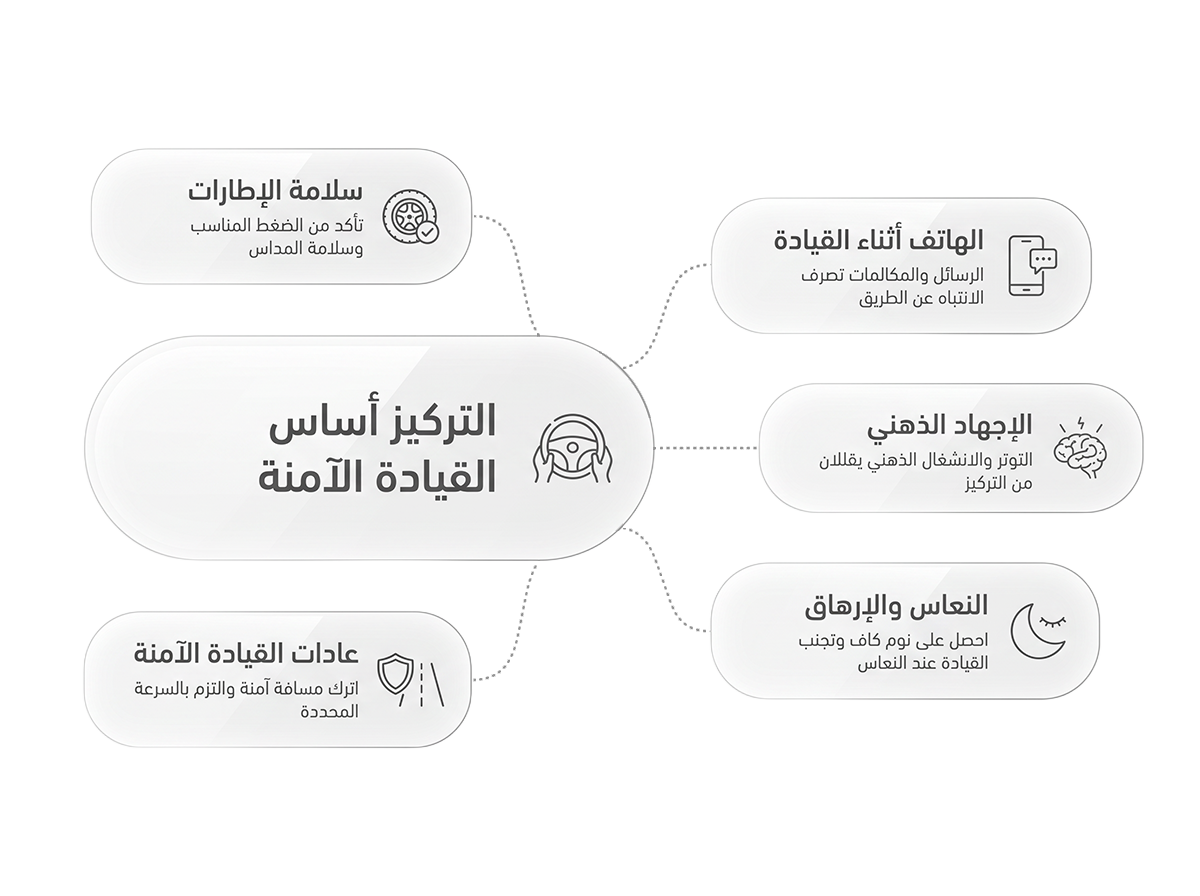
The sources of distraction facing drivers on Saudi roads are varied, most notably:
- Using a mobile phone
This behavior is classified as one of the most prominent distractions causing accidents. The Kingdom's traffic regulations have tightened penalties for using a phone by hand while driving, classifying it under the third category of the traffic violations schedule.
The problem is that just taking a quick look at a phone screen for five seconds while driving at 100 km/h means traveling a distance of nearly 140 meters without actually seeing the road.
"Just a quick five-second glance at your phone screen while driving at 100 km/h means traveling nearly 140 meters without actually looking at the road."
- Eating and drinking
It may seem simple, but the distraction of opening a package or eating a sandwich consumes attention that should be directed entirely toward the road.
- Distractions from secondary tasks
The Saudi Traffic Department has specifically warned against distractions such as grooming or applying perfume while driving, emphasizing that constant vigilance and focus are the true guarantees of safe driving.
- Emotionally charged conversations
Whether with passengers or over the phone, heated discussions increase the driver's mental load and reduce their ability to respond quickly to changes on the road.
Even more dangerous is the fact that drivers often do not realize the extent of their performance decline while distracted, because the human brain cannot truly perform two tasks that require focus at the same time; it switches between them rapidly, creating dangerous cognitive gaps that may last only fractions of a second, but are enough to cause a disaster.
- High mental load
Scientific studies indicate that driving performance is negatively affected by both high and low mental loads. When the mental load is high, different tasks compete for the brain's limited resources, leading to a decline in performance.
Conversely, when the mental load is very low—such as during long-distance driving on straight, monotonous roads—the likelihood of "mind-wandering" and decreased alertness increases, which also impairs performance.
This explains why accidents sometimes occur on straight highways where there is nothing to actively demand the driver's attention. The human brain naturally seeks stimulation, and when it doesn't find it in driving, it becomes occupied with other thoughts, from work problems to household arrangements. Here, driving ability decreases without the driver realizing it until it is too late.
The impact of tires on driving ability: A factor many overlook
It might be surprising to mention tires in an article about the causes of reduced driving ability, but the reality is that the condition of the tires directly affects the driver's ability to maintain control of the vehicle. As the only point of contact between the vehicle and the road, any defect in them is immediately reflected in driving performance.
- Incorrect tire pressure
Low tire pressure leads to increased rolling resistance and lateral drift, which increases the effort the driver must exert to keep the vehicle straight.
For every 5 PSI drop in tire pressure, fuel consumption increases by up to 2%. Tire temperature also rises dangerously, which can lead to a sudden blowout and total loss of vehicle control, especially at high speeds.
As for over-inflated tires, they reduce the contact area with the road, weaken stability in turns, and negatively affect the driver's ability to maneuver safely.
- Tire tread wear
When the tire tread depth falls below the legal minimum of 1.6 mm, the tire's ability to displace water and maintain grip on the road surface decreases significantly.
This means that a driver could lose control of the vehicle during sudden braking or when driving on wet roads, without any direct error on their part.
The result is a significant decrease in safe driving ability, not due to poor driver skills, but because the tires fail to translate the driver's inputs into actual road response.
- Tires unsuitable for the Saudi climate
Given the hot and dry climate that prevails in most regions of the Kingdom, where temperatures rarely drop below 7°C, summer tires specifically designed for hot conditions are more effective and safer than all-season tires. The latter are designed to handle snow and mud—conditions rarely encountered by Saudi drivers—and consequently, they wear out faster in high heat and provide less grip on hot asphalt, reducing the safety margin available to the driver when a sudden maneuver is needed.
The fundamental question here is: why would driving ability decrease if the tires are in good condition? The answer lies in the fact that good tires alone are not enough if they are not suitable for the climate and usage, and if they are not checked regularly.
"Good tires alone are not enough if they are not suitable for the climate and usage, and if they are not checked regularly."
Health and psychological factors
One cannot discuss a decline in driving ability without addressing the health and psychological factors that affect a driver's performance, such as sleep apnea, poorly managed diabetes, heart disease, and the use of certain medications that cause drowsiness. All of these factors reduce a driver's alertness and their ability to react quickly to emergency situations.
Psychological state also plays a pivotal role. Driving under the pressure of stress, anger, or anxiety increases mental load and distracts from the primary task. Specialized studies have indicated that personal factors, such as emotional state and driving experience, directly affect a driver's ability to focus. An agitated driver may make impulsive decisions, while an anxious driver may be overly cautious in a way that hinders traffic flow or confuses other drivers.
Harsh weather conditions in Saudi Arabia
The Kingdom of Saudi Arabia is characterized by harsh climatic conditions, including sandstorms, dust waves, and high temperatures. Sandstorms pose a major challenge to driving, as they lead to a sharp decrease in horizontal visibility and significantly reduce a driver's ability to see the road and surrounding vehicles.
Competent authorities recommend slowing down immediately and maintaining a distance of at least 200 meters from the vehicle ahead, while keeping all lights on to increase vehicle visibility to others.
Under these conditions, the driver faces a dual challenge: on one hand, reduced visibility limits their ability to gather information from the surrounding environment; on the other, they experience stress and anxiety that consume additional mental resources. The result is a clear decrease in driving ability that requires conscious compensation from the driver by reducing speed and increasing the safety distance.
Practical strategies to maintain your driving ability
Now that we have reviewed the various reasons that answer the question: why might driving ability decrease? It is time to move on to practical solutions that drivers can apply to protect themselves and others:
1. Get enough sleep—at least 7 hours—before long trips, especially when traveling between cities.
2. Inspect your tires carefully: Check tire pressure, tread depth, and look for any cracks or bulges.
3. Ensure the vehicle is in good overall condition, including brakes, lights, and windshield wipers.
4. Avoid driving if you are taking medications that cause drowsiness or if you are in an unstable emotional state.
5. Place your phone in a position where you cannot easily reach it, or use "do not disturb" apps while driving.
6. Take a break at least every two hours on long trips, even if only for 15 minutes to stretch your legs and get some fresh air.
7. Adhere to speed limits and maintain a safe distance between you and the vehicle in front of you.
8. Use turn signals when changing directions or switching lanes.
9. In the event of a sandstorm, reduce your speed, turn on your headlights, and use hazard lights if necessary.
In conclusion, what causes impaired driving? It may seem like a simple question, but the answer makes all the difference between a safe journey and a tragic crash. Remember, reduced driving ability does not happen out of nowhere; it builds up through interrelated factors, starting within your own body—such as drowsiness and fatigue—and extending to vehicle condition and surrounding road factors.
"A decline in driving ability doesn't happen suddenly without warning; it builds up through interconnected factors, starting from within your own body—such as drowsiness and fatigue—and extending to the condition of your vehicle and the road conditions around you."