Fuel economy is one of the most important criteria influencing a car purchase decision, as it represents a recurring financial burden for the owner throughout the vehicle's lifespan.
In reality, many people overlook the gap between the fuel consumption figures announced by manufacturers and actual on-road consumption, which ranges from 15% to 25% in conventional vehicles.
This discrepancy is due to the difference between laboratory testing conditions and real-world road conditions, as well as the driver's driving style. How a driver handles the accelerator, brakes, vehicle speed, and the decision to turn off the engine or leave it idling all impact the amount of fuel the car consumes.
In this article, we aim to clarify the relationship between various driving styles and fuel economy, drawing on the latest scientific studies and field tests, while providing practical recommendations to improve fuel efficiency.
"Actual fuel consumption exceeds manufacturer figures by 15-25% in conventional vehicles; this difference is due to the driver's style, not just laboratory testing conditions."
The Concept of Eco-Driving
To begin, it is important to define eco-driving, which consists of a set of practices and techniques aimed at improving fuel consumption and emissions by optimizing driver behavior. These practices include reducing idling, accelerating moderately, minimizing braking, and maintaining a steady speed.
Eco-driving offers tangible benefits for the driver, the environment, and society alike. This strategy directly helps curb operating costs, ensuring a reduction in fuel consumption by between 3.5% and 10.1%.
Eco-driving has also successfully reduced fuel consumption by 7% in rural areas, which has had a positive impact on air quality by lowering carbon dioxide emissions, while also recording a sharp decline in more toxic gases.
Furthermore, this type of driving enhances road safety, protects lives, and reduces the likelihood of traffic accidents, making it an essential choice for achieving environmental sustainability, financial savings, and physical safety on the roads.
The Relationship Between Driving Style and Fuel Economy
An internal combustion engine converts the chemical energy stored in fuel into kinetic energy to propel the vehicle, losing a significant portion of that energy as heat and friction during the process.
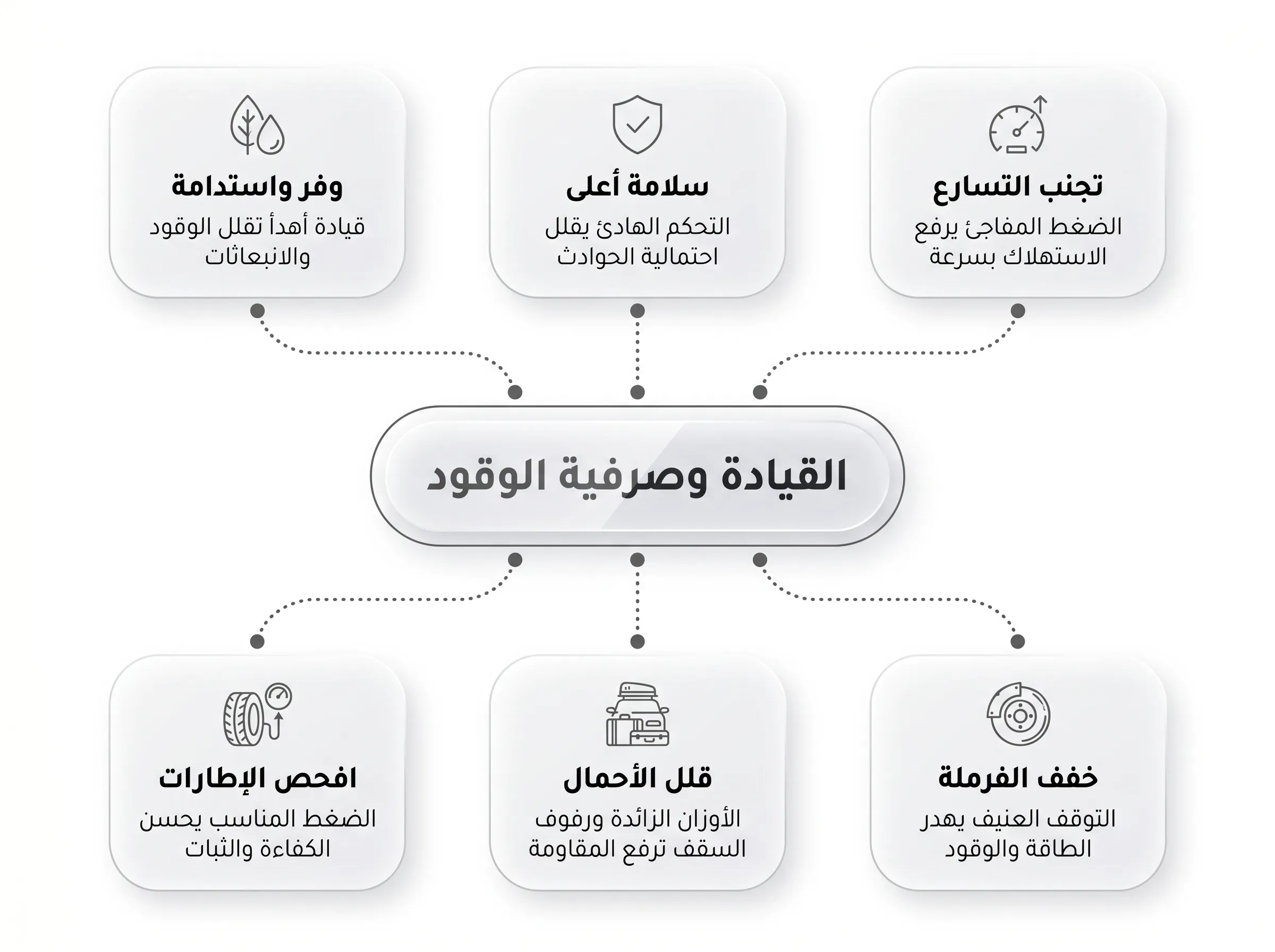
When a driver adopts an erratic driving style, such as sudden acceleration or harsh braking, the engine is forced to operate outside its optimal RPM and load ranges, which increases energy loss and raises fuel consumption.
Studies indicate that driving style directly affects fuel consumption and carbon dioxide emissions, and researchers have developed
Studies indicate that driving behavior is a vital factor affecting fuel consumption and carbon dioxide emissions, yet it is often overlooked in current estimation models. Researchers have developed advanced methods to link driving style with fuel consumption rates, integrating traditional statistical analysis with modern machine learning techniques, which underscores the growing scientific importance of this field.
How Rapid Acceleration Drains Your Fuel TankH?
Rapid acceleration is one of the most fuel-wasting habits. When a driver presses hard on the accelerator, the engine is injected with a large amount of fuel to provide the required torque, but combustion efficiency in this scenario is lower than it is during gradual acceleration.
Statistics indicate that rapid acceleration can reduce fuel economy by up to 40%. This means that a driver who habitually accelerates quickly from traffic lights or makes sudden passes may consume twice as much fuel compared to a driver who accelerates gradually.
Rapid acceleration wastes up to 40% of fuel, causing drivers who habitually accelerate aggressively to double their consumption compared to those who accelerate smoothly and steadily.
The impact of inconsistent speed and sudden braking on fuel efficiency
Hard braking is closely linked to rapid acceleration in an inefficient cycle, where the driver wastes the energy gained from accelerating and dissipates it as heat through the brakes.
Pressing hard on the brakes indicates that the driver did not anticipate traffic flow effectively, forcing them to stop suddenly and then accelerate again. This cycle repeats, a driving pattern particularly common in urban environments with frequent traffic lights and stops, which strains the engine and increases consumption.
Other studies indicate that frequent acceleration and sudden changes in speed increase gasoline consumption by up to 20%. Furthermore, switching between two different speeds every 18 seconds raises fuel consumption by 20%, demonstrating that inconsistent speed—even within a reasonable range—leads to significant fuel waste.
The impact of excessive speeds on air resistance and fuel consumption
Speed is a critical factor in fuel consumption, as air resistance increases in proportion to the square of the speed. This means that any modest increase in speed leads to a significant multiplication of the force required to propel the vehicle.
Statistics show that mid-sized gasoline-powered cars achieve peak efficiency at speeds of approximately 89 km/h, with efficiency dropping noticeably at higher speeds.
For example, driving at 121 km/h increases gasoline consumption by about 25% compared to driving at 72 km/h. The physical explanation for this is that doubling the speed increases air resistance exponentially; a car traveling at 121 km/h is about 1.7 times faster than one at 72 km/h, but due to the square relationship, air resistance increases to approximately 2.8 times, forcing the engine to exert much more energy to overcome it.
Industry experts emphasize the need to ease off the accelerator in traffic congestion and avoid aggressive acceleration. They confirm that reducing speed from 130 km/h to 110 km/h, for instance, saves up to approximately 20% in fuel.
Due to physical air resistance, a speed of 121 km/h increases consumption by 25% compared to 72 km/h, while reducing speed from 130 to 110 km/h ensures savings of about 20%.
How do temporary stops waste your car's fuel?
Drivers often overlook the fact that keeping the engine running while stopped consumes fuel without providing any kinetic benefit. Idling for more than 10 seconds consumes more fuel than restarting the engine; therefore, it is recommended to turn off the engine when the stop exceeds 15 seconds, especially in traffic jams.
Engine idling also contributes significantly to increased fuel consumption, especially in urban environments with frequent long stops at traffic lights or in traffic jams. Studies indicate that reducing idling is one of the cornerstones of fuel-efficient driving.
Keeping the engine running while stopped for more than 10-15 seconds wastes more fuel than restarting it, so it is recommended to turn it off in traffic jams and during long stops.
Other factors related to driving style
There are other factors directly influenced by driver decisions that affect fuel consumption, most notably:
Load
Carrying unnecessary luggage or installing roof racks increases weight and air resistance, thereby raising fuel consumption.
For example, a large cargo box on the roof increases aerodynamic drag and reduces fuel economy. Similarly, opening windows or carrying bicycles on the roof significantly impacts fuel efficiency by increasing air resistance.
Using Air Conditioning
The air conditioner draws power from the engine and can increase fuel consumption by up to 10%. It is recommended to limit its use whenever possible, especially at lower speeds where opening windows is a viable alternative. However, keep in mind that opening windows at high speeds also increases air resistance.
Regular Maintenance
A well-maintained engine consumes less fuel, and proper tire pressure has a direct impact on efficiency; a drop in tire air pressure increases rolling resistance, thereby raising fuel consumption.
Examples of Smart Technologies and Systems That Reduce Fuel Consumption
- The Start-Stop system, which automatically turns off the engine when the vehicle comes to a complete stop, saves fuel in city traffic and reduces emissions.
- Standard and adaptive cruise control maintain a steady speed to save fuel on flat roads, with the "adaptive" version excelling by automatically adjusting speed based on traffic flow.
- Eco-driving mode adjusts throttle response and transmission shifting to encourage gradual acceleration and earlier gear changes in city driving.
- Smart monitoring and assistance systems provide drivers with real-time feedback to adjust their driving behavior, while reinforcement learning-based systems help minimize energy losses.
Practical Recommendations for Drivers to Reduce Fuel Consumption
Eco-driving is a smart approach that protects your engine and preserves the environment. We recommend adopting these simple daily habits behind the wheel, which can help you reduce fuel consumption by 15% to 40%:
- Accelerate gently and gradually, avoiding sudden pressure on the gas pedal.
- Anticipate traffic by looking ahead and coasting toward red lights to avoid unnecessary braking and acceleration.
- Maintain moderate speeds, as speeds exceeding 120 km/h lead to a significant increase in fuel consumption.
- Use cruise control on highways to maintain a constant speed.
- Turn off the engine when stopped for more than 10–15 seconds.
- Avoid carrying unnecessary loads and remove roof racks when not in use.
- Limit the use of air conditioning whenever possible.
- Maintain proper tire pressure and perform regular vehicle maintenance.
- Combine trips and avoid multiple short journeys that prevent the engine from reaching its optimal operating temperature.
- Avoid idling the car for long periods; modern vehicles need no more than 30 seconds to be ready to drive, and prolonged morning warm-ups are a direct waste of fuel.
- Be sure to use the oil viscosity specified in your vehicle's manual; oils with excessively high viscosity increase internal engine resistance and raise fuel consumption.
- Plan your destination in advance or park in the first available spot instead of circling for several minutes to find a closer one, a habit that consumes significant fuel in a small area.
In conclusion, while you strive to make the most of every drop of fuel, you might overlook a crucial factor that directly links your car's performance to its fuel efficiency, which is Choosing the right tires.
Tires determine rolling resistance, which in turn affects fuel consumption by up to 20%. Furthermore, improper tire pressure, using tires unsuited to your driving needs, or even choosing the wrong sizes directly leads to additional fuel consumption and unnecessary operating costs.
"Tire rolling resistance and improper pressure affect fuel consumption by up to 20%."
Don't worry, especially since Darbak provides expert consultations to ensure you choose the right tires according to your vehicle's specifications and your driving conditions.. Contact us, and rest assured that it is a smart investment that saves you money, extends your car's lifespan, and improves your driving experience.